Belgian Pancakes
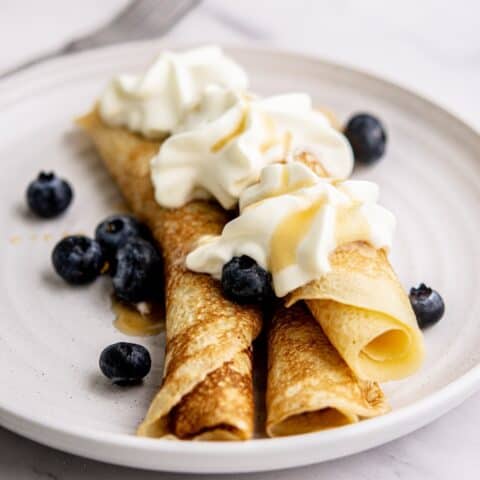
Belgian pancakes are thin, soft, and tender, with a hint of sweetness. They’re great for stacking and rolling.
Ingredients
- 250 g all-purpose flour
- 3/4 teaspoon baking powder
- 3 large eggs
- 600 g milk plus more if needed to thin the batter
- 12 g granulated sugar
- 45 g butter melted
- 1/4 teaspoon salt
Greasing
- oil or butter
Instructions
- Add the flour, eggs, melted butter, baking powder, sugar, salt, and milk in a large bowl. Whisk together until it's a smooth and runny batter. You can use an immersion blender if you have it, to make it extra smooth, or run the batter through a sieve. 250 g all-purpose flour, 3/4 teaspoon baking powder, 3 large eggs, 600 g milk, 12 g granulated sugar, 45 g butter, 1/4 teaspoon salt
- Let the batter rest for 15 minutes. If you find your batter too thick, add extra milk as needed. It should be the consistency of thin pourable cream. The batter should be runny enough to spread immediately when you tilt the pan.
- Heat a flat, low-sided crêpe pan, carbon steel, or well-seasoned cast iron over medium heat. A heavy bottom helps prevent hot spots. Non-stick is forgiving and easy to use, but it can produce paler pancakes with less flavor compared to steel or iron.
- The pan is ready when a drop of batter sizzles immediately but doesn't smoke. Lightly grease with butter or oil.
- Pour around 1/4-1/3 cup of batter into the centre of the pan, then immediately lift and tilt in a circular motion to spread it thin before it sets. Cook until the top looks dry and matte with edges lifting slightly, around 1–2 minutes. Loosen the edges with a thin spatula, then flip. Cook the second side until golden, around 30–60 seconds, depending on your pan heat. The first pancake is always a test and you can adjust your heat from there.
- Repeat with the remaining batter and stack the cooked pancakes on a plate.
Notes
Both metric and US cup conversions are provided. Use the toggle to switch between the two.
Cooking notes
-
- Preheat your pan enough. If the pan is too cold, the pancake will stick. More often than not, the first pancake will stick while you learn your pan's heat. Just think of it like a tester.
-
- Grease the pan lightly with butter or oil, spreading it evenly with a paper towel to prevent sticking but without adding too much.
-
- Pour the batter into the center of the pan and quickly swirl it around to coat the surface for an even, thin pancake.
-
- Flip when the surface of the pancake dries out. Use a thin spatula to loosen the edges, then flip gently.
-
- Adjust the heat as needed to prevent pancakes from browning too quickly or unevenly. You'll need to get to know your own stove and what works best.
Nutrition
Serving: 1pancakeCalories: 131kcalCarbohydrates: 16gProtein: 4gFat: 6gSaturated Fat: 3gPolyunsaturated Fat: 0.4gMonounsaturated Fat: 1gTrans Fat: 0.1gCholesterol: 51mgSodium: 115mgPotassium: 93mgFiber: 0.5gSugar: 3gVitamin A: 219IUCalcium: 70mgIron: 1mg
Tried this recipe?Let us know how it was!