Kouign Amann Recipe
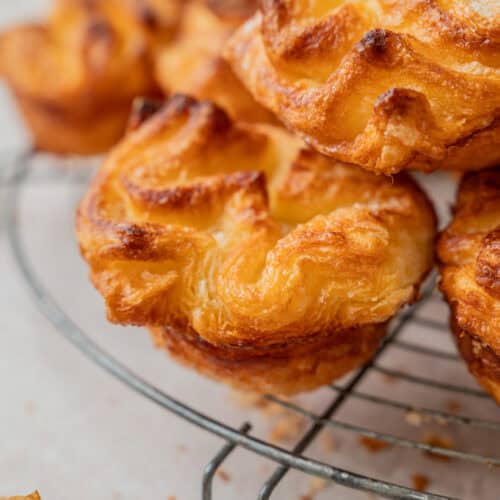
Kouign amann are flaky Breton pastries with caramelized sugar and buttery layers. These are made from a simple laminated dough.
Ingredients
Dough (détrempe)
- 7 g instant yeast or active dry yeast
- 20 g granulated sugar
- 240 g water
- 405 g all-purpose flour plus extra for dusting
- 8 g salt
Butter Block (beurrage)
- 220 g unsalted butter cold
Sugar for shaping and folding
- 100 g granulated sugar divided
Instructions
Make the dough
- If using active dry yeast, warm the water to 95-104°F (35-40°C) and combine with the yeast and sugar in a large bowl. Leave for 5-10 minutes until foamy. If it doesn't foam, you'll need a fresh packet. If using instant yeast, skip this step and combine all the dry ingredients directly. 7 g instant yeast, 20 g granulated sugar, 240 g water
- Add the flour and salt and mix until a shaggy dough forms. 405 g all-purpose flour, 8 g salt
- Turn out onto a lightly floured surface and knead for 6-8 minutes until smooth.
- Shape into a rectangle, wrap tightly in plastic wrap, and refrigerate for at least 2 hours or overnight.
Butter block
- Slice the cold butter into 4 slices and lay them in a grid between two sheets of baking paper. Pound with a rolling pin until the pieces merge, then roll into a 20x15cm (8x6 inch) rectangle, folding the paper to make the rectangle shape. Refrigerate until firm. 220 g unsalted butter
- Before laminating, press a knuckle into the butter. It should leave a soft dent without cracking and the butter should be nice and bendy. If it's too firm, pound it again with a rolling pin until it becomes pliable.
Laminating
- Take the chilled dough out of the fridge and roll it into a rectangle roughly twice the width of your butter block.
- Place the butter block in the centre. Fold the sides of the dough over to encase the butter and pinch the edges to seal.
- Turn the dough so the seam runs vertically. Roll out into a long rectangle about 8mm thick. Trim the short edges to expose the layers. Dust off any excess flour.
- Fold the top third down and the bottom third up (like a letter). This is your first fold. Wrap and refrigerate for 30 minutes.
- Second fold: Repeat roll out and fold.This is your second fold. Wrap and refrigerate for 30 minutes.
- Third fold: Take the dough out of the fridge. Roll it out into a large rectangle, about 8mm thick.
- Sprinkle around 50g of the sugar evenly over the surface and use a rolling pin to gently press the sugar in. 100 g granulated sugar
- Fold the top third down and the bottom third up. You can chill the dough for 20-30 minutes if the butter is getting too warm, or go right to shaping if not. Don't leave it too long before shaping or the sugar will begin to pull moisture from the dough and become sticky.
Shape
- Butter 12 muffin cups.
- Roll the dough to about 4-5mm thick into a 30x40cm (12x16 inch) rectangle.
- Trim the edges to neaten. Make 3 cuts along the 40cm length to give 4 strips, then 2 cuts across each strip to give 3 pieces. You'll have 12 squares of roughly 10x10cm.
- Sprinkle the remaining 50g of sugar on a plate. Grab a square and dip it on both sides so it's coated. Fold the corners of each square into the centre and press gently to seal. Place into the prepared muffin cups, folded side up.
- Cover loosely and proof at room temperature for 1.5 to 2 hours, until visibly puffed and the layers are starting to show. They don't need to double.
Bake
- Preheat the oven to 200°C (400°F).
- Bake for around 20-22 minutes until deeply golden and the caramel is bubbling around the edges. They should look quite dark. Don't pull them early.
- Remove from the oven and immediately lift each kouign-amann out with tongs. The caramel sets quickly as it cools and they will stick if left in the tin. Be careful, the caramel is extremely hot.
- Cool for at least 10 minutes before eating. The caramel will be extremely hot straight from the oven.
Notes
-
- Use European-style butter with at least 82% fat for best results. Higher fat content means less water in the butter, which keeps your layers cleaner and more distinct.
- Keep everything cold. If the butter starts to feel greasy or the dough warms up during lamination, put it back in the fridge for 20 minutes before continuing.
- Work quickly after the sugar fold. Sugar draws moisture from the dough, making it progressively stickier. Shape within 30 minutes of the sugar fold.
- Remove from the tin immediately using tongs. The caramel sets quickly as it cools.
- Weigh your ingredients for the most accurate results. Use the toggle to switch between metric and US measurements, but I recommend grams.
- Kouign-amann are best eaten warm, within a few hours of baking. To refresh on the following days, reheat at 180°C (350°F) for 5-7 minutes.
- Both US customary and metric measurements are provided. Use the toggle to switch between the two.
Nutrition
Serving: 1gCalories: 295kcalCarbohydrates: 36gProtein: 4gFat: 15gSaturated Fat: 9gPolyunsaturated Fat: 1gMonounsaturated Fat: 4gTrans Fat: 1gCholesterol: 39mgSodium: 262mgPotassium: 46mgFiber: 1gSugar: 10gVitamin A: 458IUVitamin C: 0.002mgCalcium: 10mgIron: 2mg
Tried this recipe?Let us know how it was!