Lemon Curd Donuts
These lemon curd donuts are made with soft brioche dough and filled with sweet and tangy lemon curd.
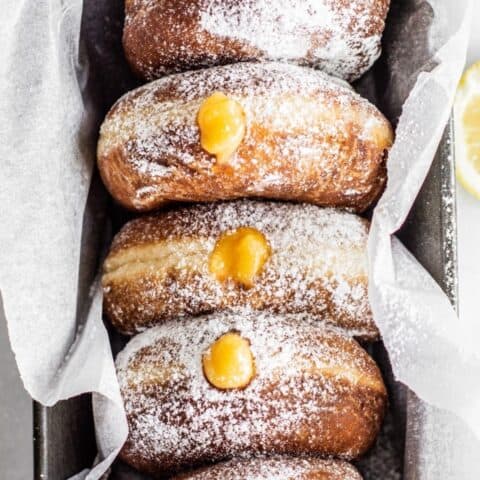
Ingredients
- 120 g warm milk 95-104°F / 35-40°C
- 25 g granulated sugar
- 1 ½ teaspoon instant yeast or active dried yeast
- 375 g all-purpose flour
- 2 large eggs
- ¾ teaspoon salt
- 1/2 teaspoon vanilla paste or extract
- 113 g butter room temperature
- Powdered sugar for dusting
Lemon curd
- 3 large egg yolks
- 1 large whole egg
- Pinch of salt
- 120 g fresh lemon juice
- 2 tablespoon lemon zest
- 150 g granulated sugar
- 100 g butter cold, cubed
Frying
- Neutral vegetable oil - enough to fill the pot at least 3" deep.
Instructions
The dough
- In a bowl of a stand mixer fitted with a dough hook, or a mixing bowl, add the warm milk and stir in the yeast and sugar. If using active dry yeast, let this sit for 5-10 minutes until foamy.
- To the yeast mixture, add the eggs, flour, vanilla and salt. Turn the mixer on low speed or use your hands to combine until it forms a thick dough. Mix this dough for around 5 minutes to begin developing the gluten. It will be a stiff dough.
- Add in the room temperature butter, a few cubes at a time. Incorporate each cube, either by hand or with the mixer, before the next addition.
- Keep kneading until the sticky dough starts to strengthen and come together. In the mixer, it should pull away cleanly from the sides of the bowl. For the best gluten development and brioche crumb, keep the dough mixing for at least 10-15 minutes. The dough should feel smooth, soft, and strong.
- Shape the dough into a ball and place it into a lightly greased bowl. Cover the bowl with a lid, plate, plastic wrap, or a damp tea towel, and let it proof at room temperature until doubled in size. *If making the dough overnight, it can do its rising in the fridge overnight instead.
Lemon Curd
- While the dough is rising, make the curd. In a microwave-proof bowl, whisk together the egg yolks, whole egg, and sugar until well combined. Whisk in the lemon juice and lemon zest.
- Place the bowl in the microwave and cook in 40-second increments, stirring each time for around 3-4 minutes in total. This time may increase or decrease depending on your microwave strength.
- Check that the curd is thick enough by dipping in a metal spoon. The curd should easily coat the back of the spoon.
- Stir the cold cubed butter through the hot curd and stir until smooth. Pour the finished curd through a sieve into clean jars. It will thicken as it cools. Keep it in the fridge until ready to use.
Shaping
- Punch down the dough and pull it from the bowl onto a lightly floured surface. Roll it into a ½ inch/ 1.3cm thick rectangle.
- Use a cookie cutter or jar lid to cut out round donuts about 3.5 inches/9 cm in diameter. Place each cut donut onto some parchment paper.
- Any scraps of dough can be kneaded back into a ball and rolled out again. Leave the dough ball to rest for at least 10 minutes before rolling out again. This allows the gluten to rest again so the dough doesn't spring back when rolled.
- Let the donuts rest for another hour until they are puffy. Use kitchen scissors to cut around each donut on the parchment paper so each donut is sitting on an individual piece of parchment.
Frying
- When to ready to fry, pour the frying oil into a deep fryer or a deep pot and heat it to around 340°F- 347°F (171°C- 175°C).
- Carefully drop 1-2 donuts into the oil and remove the parchment paper with tongs. Fry the donuts for 2 minutes, then flip them and fry for a further 2 minutes on the other side.
- If you're not using a deep fryer (which usually comes with a thermometer) you'll need a candy thermometer for this.
- Ensure the oil in the pot stays hot, but don't let it surpass 350°F / 177°C or the donuts will burn before they have a chance to cook in the middle.
- Continue with the rest of the donuts. Let the fried donuts drain on a rack and cool completely before filling.
Filling
- Scoop the lemon curd into a piping bag fitted with a round tip. Insert the tip of a small knife into the side of each donut to make a hole for the filling.
- Pipe the curd through the hole into each donut. Place the filled donuts onto a rack and dust them generously with powdered sugar all over.
- The filled donuts are best served immediately. Leftover unfilled donuts can be stored in an airtight container at room temperature for up to 2 days. Wait to fill them until serving and store leftover filled donuts in the fridge.
Notes
- Both metric and US cup measurements are available - Just use the toggle on the recipe card.
Nutrition
Serving: 1doughnutCalories: 339kcalCarbohydrates: 41gProtein: 6gFat: 17gSaturated Fat: 10gPolyunsaturated Fat: 6gTrans Fat: 1gCholesterol: 102mgSodium: 147mgFiber: 1gSugar: 17g
Tried this recipe?Let us know how it was!