Homemade Golden Syrup
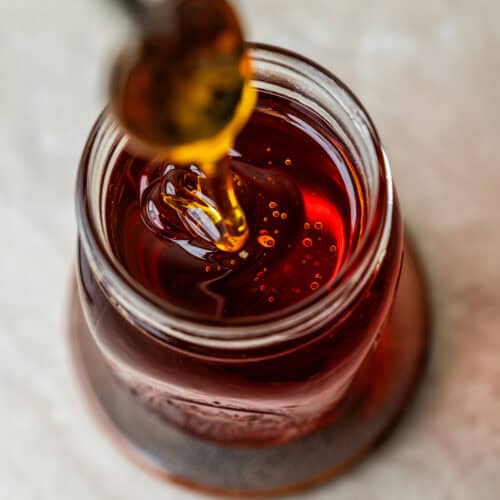
A thick, glossy homemade golden syrup that flows slowly from a spoon in a ribbon. Caramelizing just a little of the sugar brings rich flavor without a long simmer.
Equipment
- Heavy-bottomed saucepan
- Candy thermometer
- Clean heatproof jar
Ingredients
Golden syrup
- 500 g granulated sugar divided
- 160 g water divided
- 2 tsp lemon juice
- 2 tsp molasses Optional for deeper flavor. Use dark or blackstrap molasses, or treacle.
Instructions
Caramelize the sugar
- Add 50 g (1/4 cup) sugar and 15 g (1 tablespoon) water to a heavy-bottomed saucepan. Heat over medium heat until the sugar caramelizes to a deep amber color. Gently swirl the pan rather than stirring vigorously as it changes color.
- Remove the pan from the heat and let the caramel cool for a few minutes.
Dissolve the remaining ingredients
- Carefully add the remaining 145 g of water to the pan. Gently warm it and stir until the hardened caramel dissolves. Be careful because the mixture might still sputter up or steam.
- Add the remaining 450 g sugar and lemon juice. Stir over gentle heat until all the sugar is completely dissolved.
Cook to temperature
- Bring to a gentle boil and stop stirring. Cook until the syrup reaches approximately 240°F (116°C) on a candy thermometer. Be careful to not scrape sugar crystals from the sides of the saucepan into the syrup when using the thermometer.
- Remove from the heat and stir in the molasses, if using.
Cool and store
- Let cool in the saucepan for 5 to 10 minutes, then carefully transfer to a clean, dry, heatproof jar. Leave uncovered until completely cool, then seal and refrigerate. The syrup will look very watery while hot but becomes thick and scoopable as it cools, flowing from a spoon in a slow, glossy ribbon.
Notes
Consistency: The syrup looks extremely thin and watery while hot. Do not judge it until fully cooled to room temperature. Once cooled entirely it should be thick and scoopable but still flow slowly in a glossy ribbon. After initially letting it cool down until warm at room temperature, you can pop it in the fridge to speed up the cooling.
Why caramelize only 50 g? This builds caramel color and flavor quickly, without simmering the entire batch for a long time.
Temperature: Aim for around 240°F (116°C). Cooking for a set time instead can lead to runny syrup or a batch that becomes rock hard as it cools. A candy thermometer is more reliable than visual tests.
Without a thermometer: Chill a plate in the freezer for 10 minutes. Drizzle a little syrup onto it, let cool briefly, then tilt. The syrup should move slowly, but remember that the cold plate makes it appear thicker than it will at room temperature. Err on the side of stopping early; after the entire batch has cooled, you can gently reheat and cook it longer if too thin.
Molasses: Optional, but it adds darker color and some of the mineral, treacly notes of New Zealand Chelsea Golden Syrup. Without it, the flavor is cleaner and closer to Lyle's Golden Syrup.
Too thick: Gently warm with a small amount of water to loosen. If crystallized, that's different from being over-reduced; lemon juice helps limit crystallization but does not prevent overcooking.
Storage: Keep in a clean, dry, airtight jar in the refrigerator and use within one month as a cautious guideline, since this homemade syrup has not been shelf-life tested. Let come to room temperature to scoop.
Nutrition
Serving: 1servingCalories: 98kcalCarbohydrates: 25gProtein: 0.002gFat: 0.1gPolyunsaturated Fat: 0.001gSodium: 1mgPotassium: 11mgFiber: 0.002gSugar: 25gVitamin A: 0.03IUVitamin C: 0.2mgCalcium: 2mgIron: 0.05mg
Tried this recipe?Let us know how it was!