



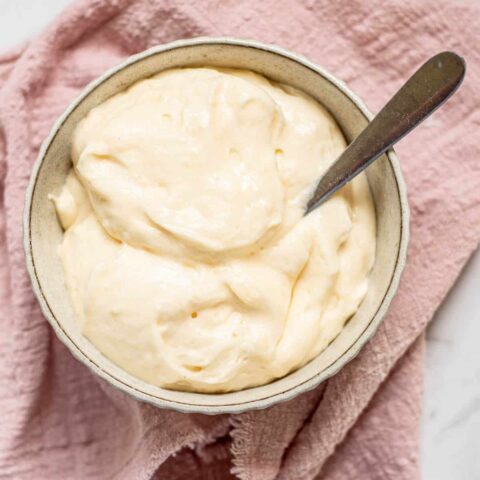
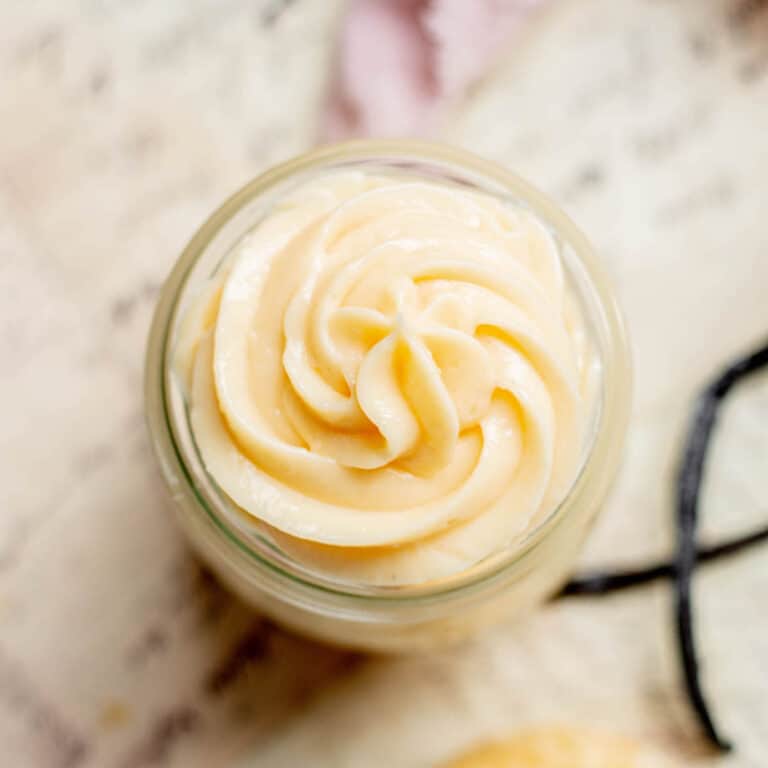
Chiboust cream is an airy twist on crème pâtissière. It’s folded with whipped meringue which brings a lightness to the custard that’s so delicious. Crème chiboust is a wonderful filling for eclairs, cream puffs, cakes, and fruit tarts, or as a dessert on its own with fresh fruit and chocolate.
About this chiboust cream recipe
The process of making chiboust cream involves folding silky Italian meringue into thick vanilla crème pâtissière. It makes a fluffy and stable mixture that’s perfect for filling delicate pastries like the famous Gâteau Saint-Honoré, or elaborate tartlets. You can also use a Swiss meringue instead of an Italian meringue. I’ve tested this recipe with both and saw no notable difference in the result, so use whichever you’re more comfortable with. If you’re not familiar with crème pâtissière yet, I’d recommend starting with my crème pâtissière recipe on its own first to get comfortable with the base custard. From there, you can build it into different creams. Crème mousseline adds whipped butter to the custard for a rich, silky result. Chiboust cream adds meringue for something lighter and airier.
This cream does require a few technical steps, but the main thing needed is time for cooling the pastry cream to room temperature before you add the meringue. Once the meringue is folded in though, use the crème chiboust right away. I really love this recipe because it uses both the egg yolks (in the custard) and the egg whites (in the meringue), so nothing goes to waste.
Key ingredients and why
Method
- This cream is made in three stages: the custard base, the Italian meringue, and then folding them together.

- Start by blooming the gelatin in cold water and set this aside.

- Heat the milk until just at a simmer, don’t let it boil.

- While the milk is warming, in a separate bowl, add the egg yolks, sugar, salt, vanilla and cornstarch. Whisk them together until glossy and smooth.

- Once your milk is hot, add the hot milk in a steady stream to the egg mixture while whisking.

- The mixture goes back on the heat and gets whisked until it bubbles and thickens. Once it starts bubbling, keep it going for a full minute. This step is really important because it deactivates the amylase enzyme in the egg yolks, which would otherwise cause the custard to go soupy as it cools.

- Once thick, whisk in the butter and bloomed gelatin off the heat, then pour it into a clean bowl. Plastic wrap goes directly on the surface to prevent a skin, and then it needs to cool completely to room temperature before moving on.
Italian meringue
- Cook the sugar and water to 240°F (115°C), the soft ball stage. While that’s heating, whip the egg whites to soft peaks.

- When the syrup reaches the correct temperature, slowly pour it in a thin stream into the beaten egg whites while continuing to whip at medium speed.

- Switch to high speed and whip the meringue until it forms stiff peaks.
Folding the crème chiboust

- Stir about a quarter of the meringue into the custard first to lighten it, then gently fold in the rest in two additions.

- Be really gentle when folding the meringue in, to avoid deflating the airiness.
Other flavors
You can flavor your chiboust cream in lots of different ways by adjusting the crème pâtissière base.
- Coffee crème chiboust: Dissolve 2 tablespoons of instant espresso powder in a small amount of hot milk or water. Add this to the milk before you bring it to a simmer. It infuses the cream with a rich coffee flavor that pairs beautifully with chocolate.
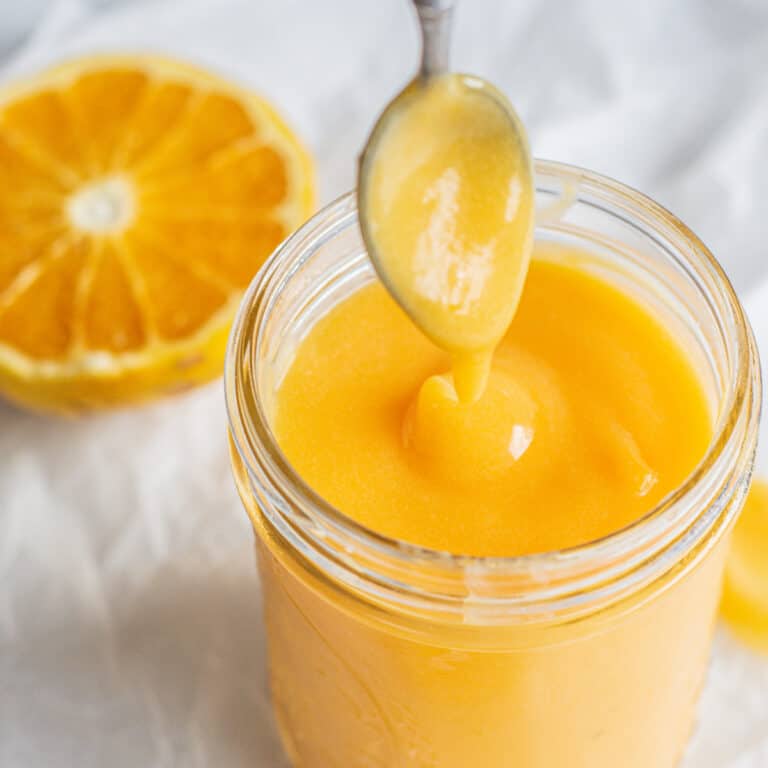
- Orange crème chiboust: Add finely grated orange zest to the milk before heating it. Strain the cooked custard to remove the zest if you prefer a smooth finish.
- Pistachio crème chiboust: Mix 2 tablespoons of pistachio paste into the hot crème pâtissière along with the gelatin and butter, and whisk until incorporated. Add a drop of green food coloring for a more pronounced color, if you like.
- Raspberry crème chiboust: Puree fresh or frozen raspberries and strain to remove seeds. Fold 2-3 tablespoons of the puree into the finished pastry cream along with the meringue.
- Liqueur crème chiboust: For an alcoholic hint, stir 1-2 tablespoons of rum, Grand Marnier, or amaretto into the cooked custard along with the butter and gelatin.

Tips
Related recipes
If you enjoyed making this chiboust cream, here are some other custard and filling recipes you might like.
- Crème Pâtissière – the classic vanilla pastry cream that forms the base of this recipe.
- Crème Mousseline – crème pâtissière enriched with whipped butter for a rich, silky texture.
- Pistachio Pastry Cream – a beautiful pistachio version of crème pâtissière.
- Basic Swiss Meringue – if you’d prefer to use Swiss meringue instead of Italian.
- Ermine Frosting – another custard-based technique, this one whipped into butter for a less sweet frosting.
Chiboust Cream – Crème Chiboust
Ingredients
Custard base
- 2 teaspoons gelatin powder
- 480 g whole milk
- 4 large egg yolks
- 65 g granulated sugar
- 1 vanilla bean scraped, or 2 teaspoons vanilla paste or extract
- 30 g cornstarch
- 1/4 teaspoon salt
- 45 g unsalted butter
Italian meringue
- 150 g granulated sugar
- 60 g water
- 4 large egg whites
Instructions
Custard base
- Stir powdered gelatin into 2 tablespoons of cold water in a small dish and leave it to soften for 10 minutes. 2 teaspoons gelatin powder
- In a medium saucepan, heat the milk on medium heat until it is just at a simmer. Don't let it boil. 480 g whole milk
- While the milk is warming, add the egg yolks, vanilla, sugar, salt, and cornstarch to a separate bowl. Whisk until glossy and smooth. 4 large egg yolks, 65 g granulated sugar, 1 vanilla bean, 30 g cornstarch, 1/4 teaspoon salt
- Place the bowl on a dampened kitchen towel. Once the milk is hot, pour the hot milk in a steady stream into the egg mixture while whisking constantly.
- Return the combined mixture to the saucepan over medium heat. Cook the custard, whisking constantly, until it starts to bubble. Once bubbling, keep it at a boil and whisk for a full minute. This is essential to deactivate the amylase enzyme in the egg yolks, which would otherwise cause the custard to become soupy as it cools.
- Take it off the heat and whisk in the butter and gelatin until smooth. 45 g unsalted butter
- Pour the pastry cream into a clean bowl (push it through a fine-mesh sieve first for extra smoothness). Lay plastic wrap directly onto the surface of the custard and let it cool to room temperature.
Italian meringue
- Begin this once the custard is at room temperature. Combine the sugar and water in a small saucepan. Heat over high heat, stirring until the sugar dissolves. Once it boils, stop stirring and let the syrup reach 240°F (115°C), the soft ball stage. 150 g granulated sugar, 60 g water
- While the syrup is cooking, whip the egg whites in a stand mixer fitted with a whisk attachment on medium speed until soft peaks form. 4 large egg whites
- When the syrup reaches the correct temperature, slowly pour it in a thin stream into the egg whites while continuing to whip at medium speed. Pour down the side of the bowl to avoid splashing.
- Once incorporated, switch to high speed and whip until stiff, glossy peaks form.
Folding
- Add a quarter of the meringue to the cooled custard and stir it in to lighten it.
- Add the remaining meringue in two parts, folding gently with a rubber spatula each time until no streaks remain. Use immediately.
Notes
- Measurements: Both grams and US cup sizes are provided. Use the toggle on the recipe card to switch between the two.
- Cook it long enough. Once the custard thickens and bubbles appear, cook and whisk for a full minute. This deactivates amylase and ensures the custard stays thick.
- Swiss meringue alternative. You can use Swiss meringue instead of Italian meringue. I’ve tested both and saw no notable difference.
- Storing. Crème chiboust should be used immediately. If needed, refrigerate for up to 24 hours, but it will deflate over time. Not suitable for freezing.
- Flavor variations. Coffee (add espresso powder to the milk), orange (infuse zest in the milk), pistachio (add pistachio paste to the custard), raspberry (fold puree in with the meringue), or liqueur (stir rum, Grand Marnier, or amaretto into the custard).
- Crème pâtissière is the base of this recipe. See that post for a full guide on making the custard on its own.

Hi. The directions don’t say when to add vanilla to the pastry cream, it also doesn’t say how much water to use in the meringue.
Thanks
Oh no I must have accidentally deleted the water! Have added it back now thanks so much 🙂