
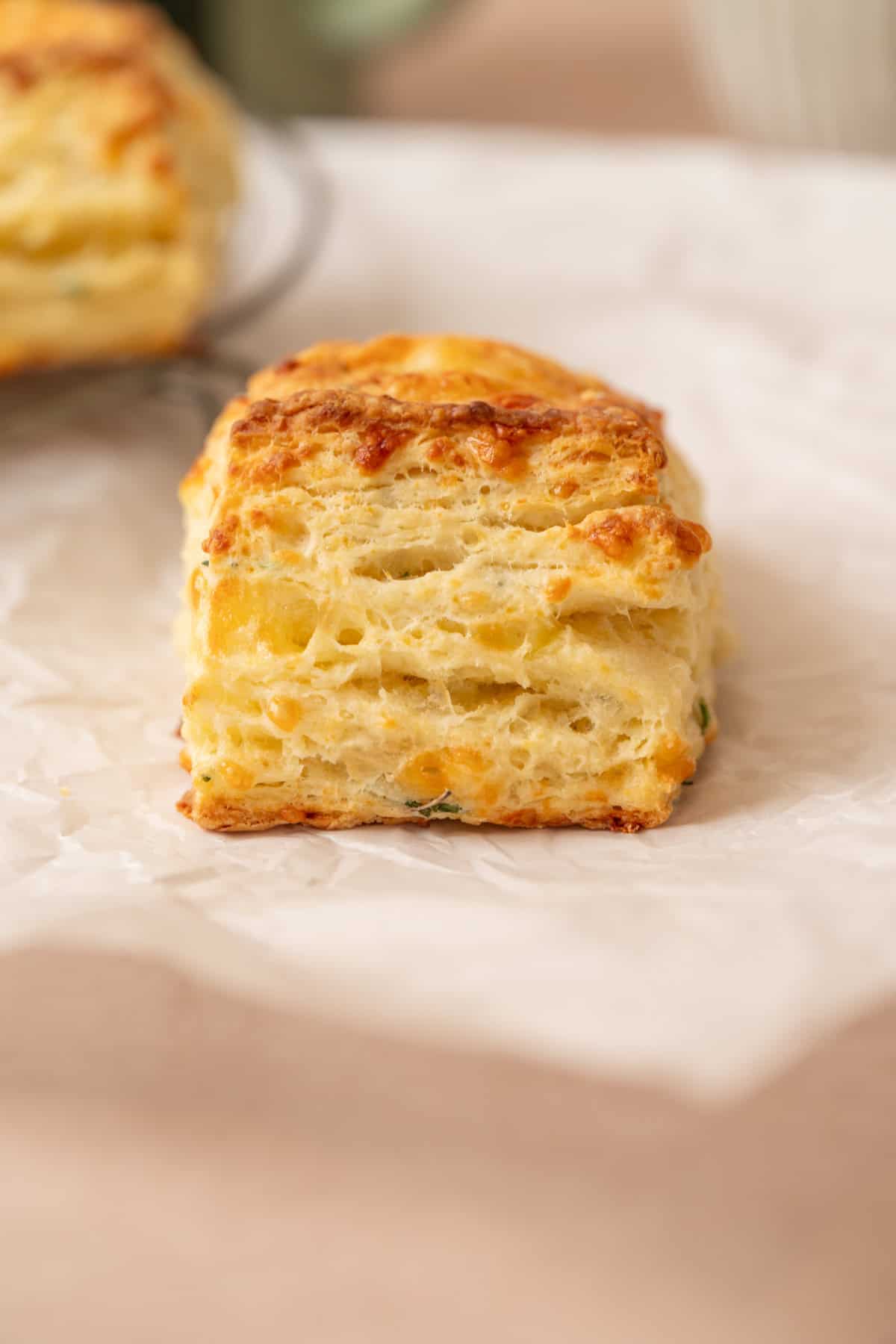

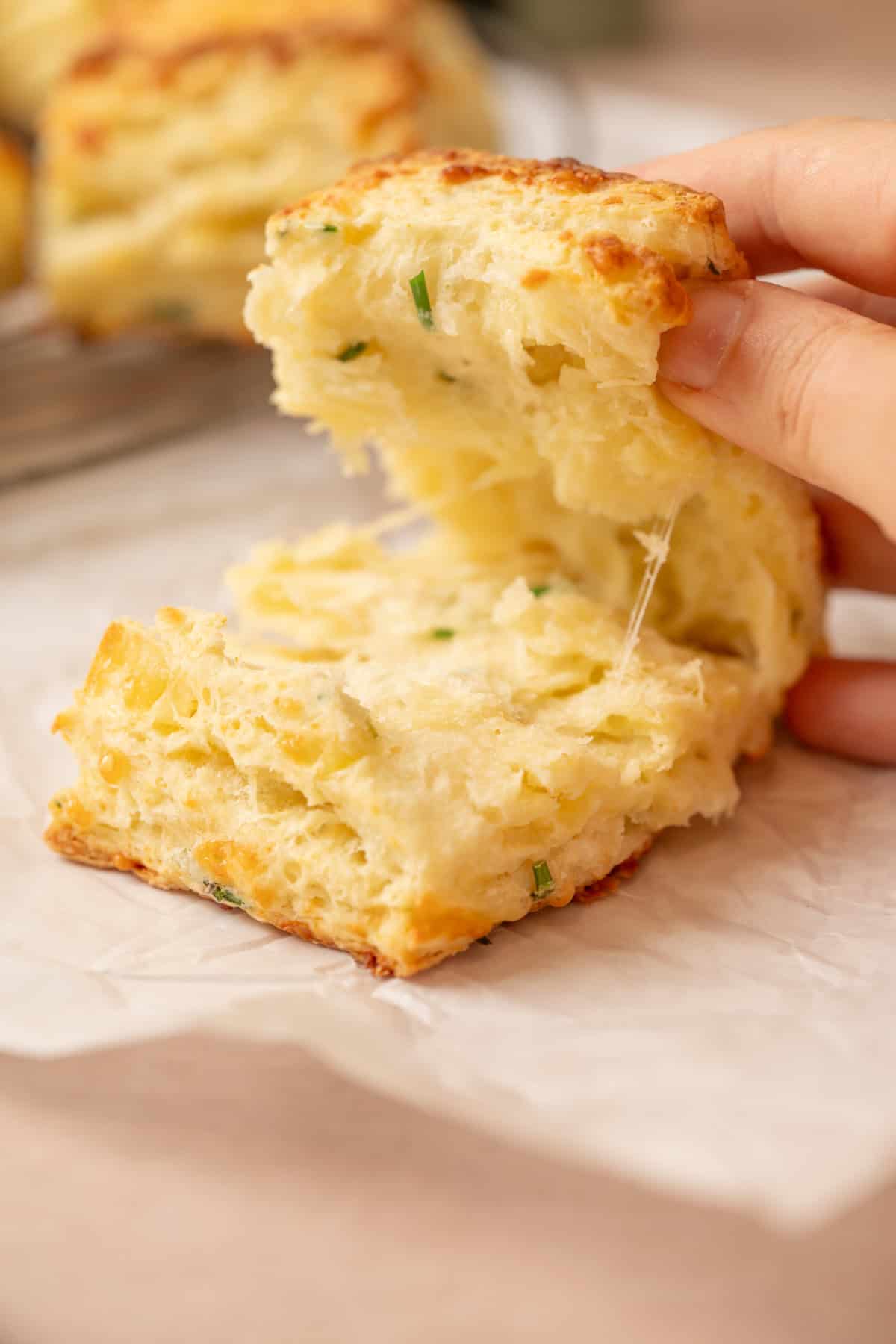
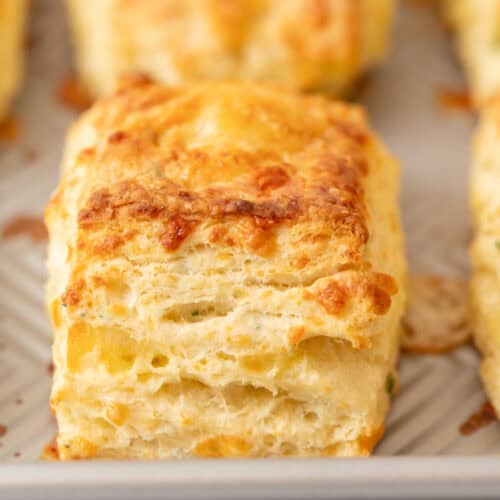
If you have sourdough discard sitting in your fridge, this is what you should make with it. These sourdough cheese scones are tender and flaky with a crispy, cheesy crust and are one of my favorite things to make with discard starter. The dough is quick to put together, and after a rest in the fridge they bake up tender and flaky with a crispy, cheesy top.
These are sourdough discard cheese scones made with a simple fold technique that builds the best flaky layers. The sourdough discard acts like a slightly acidic liquid which tenderizes the dough the same way buttermilk would. It doesn’t provide any leavening here (that’s what the baking powder is for), but it does add a very subtle tang that works beautifully with a sharp cheddar.
If you want a version without sourdough starter, my buttermilk cheese scones use the exact same fold technique and are just as good.
Key ingredients and why
- All-purpose flour gives these scones the right balance of structure and tenderness.
- Baking powder is what makes them rise nice and tall. Make sure yours is fresh, because old baking powder is one of the most common reasons scones come out flat. A full tablespoon might look like a lot, but it’s the right amount for this amount of flour.
- Unsalted butter, cold and cubed, is cut into the flour. Keeping it cold matters because those butter pieces stay whole through mixing, and when they hit the hot oven, the water in the butter turns to steam. That steam helps the scones rise and pushes the layers apart, giving you that light, flaky texture.
- Sourdough discard adds a mild acidity that inhibits gluten development and it keeps the scones tender.
- Grated cheese goes both into the dough and on top. Inside, it melts into pockets throughout the crumb. On top, it bakes into a golden, slightly crispy crust. A sharp cheese with a strong flavor makes the biggest difference here, because mild cheeses kind of disappear.
- Chives add a gentle onion flavor and a pretty pop of green. Completely optional but highly recommended.
Method
- Cut the cold butter into the dry ingredients.
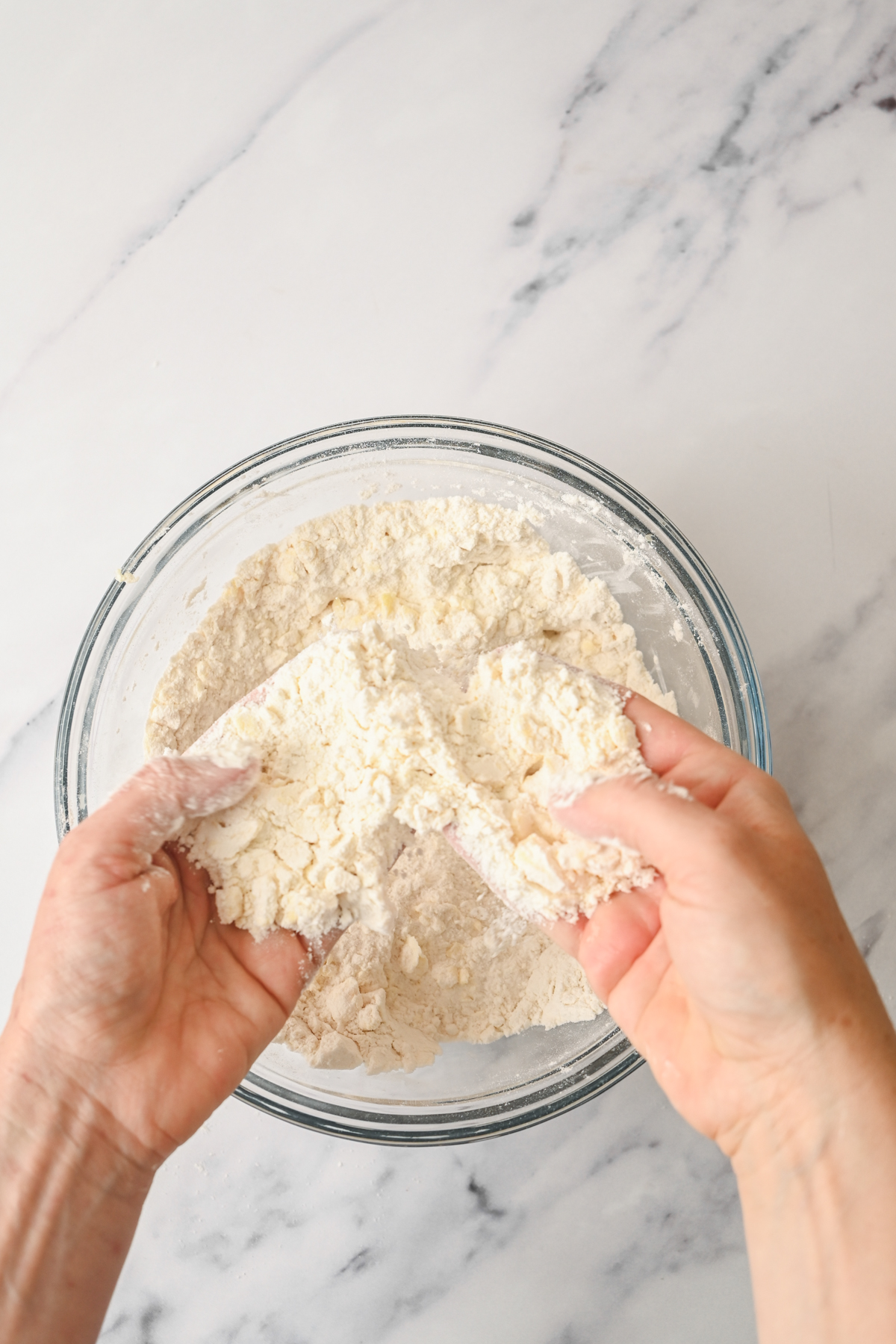
- Cut until the mixture resembles coarse, pea-sized crumbs. Work quickly so the butter stays cold.
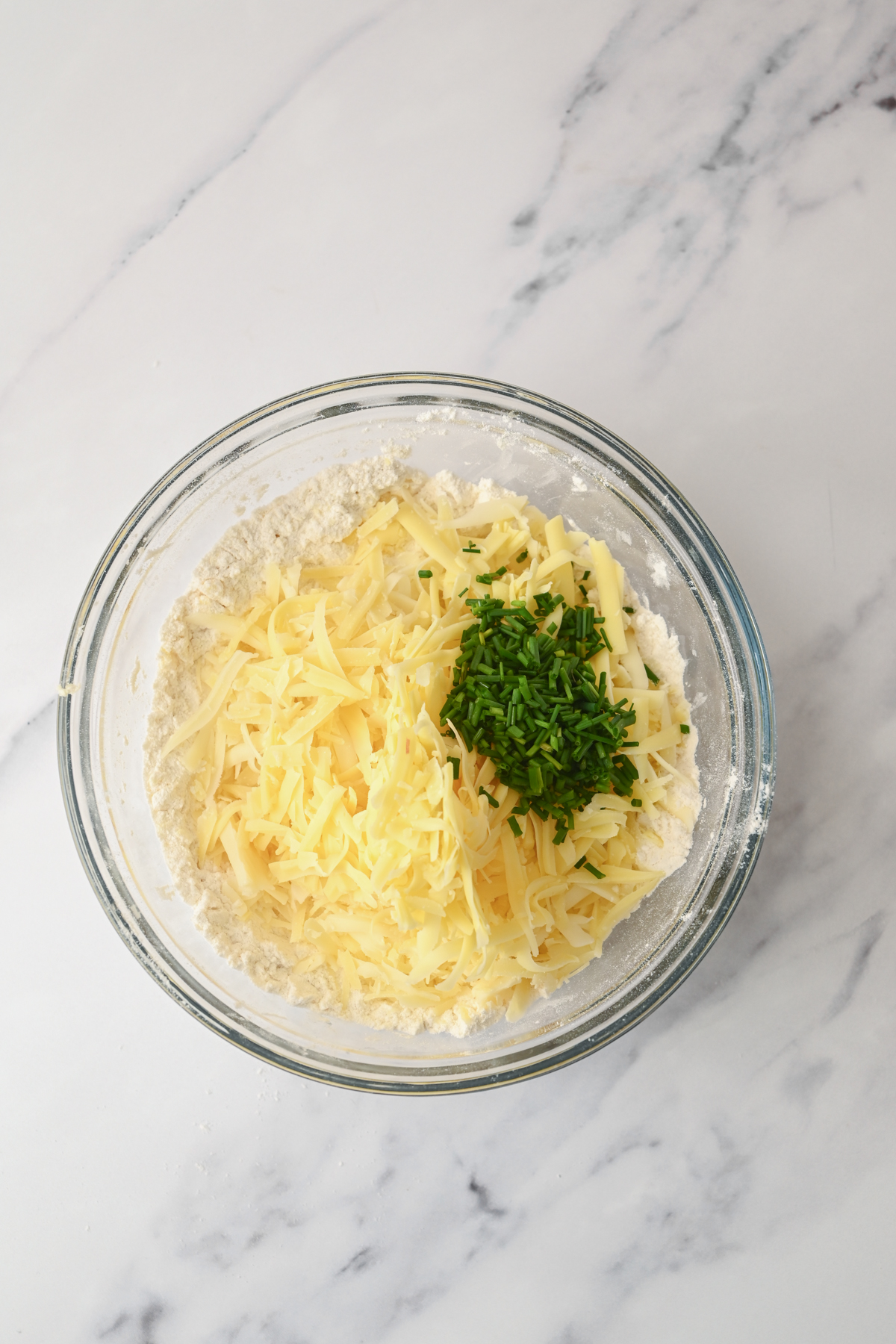
- Add the grated cheese and chives and stir it through.
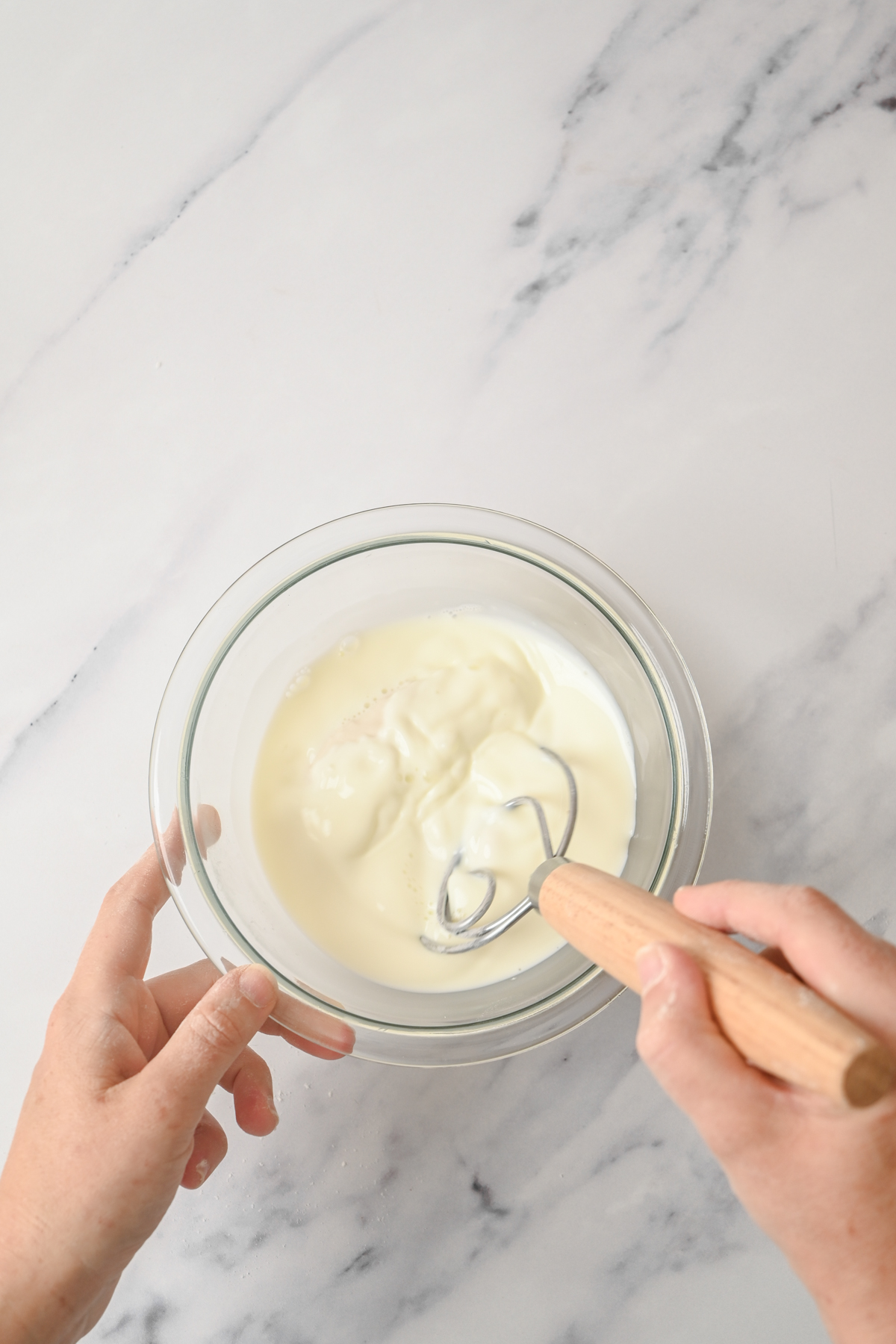
- Whisk the sourdough discard starter with milk to loosen it.
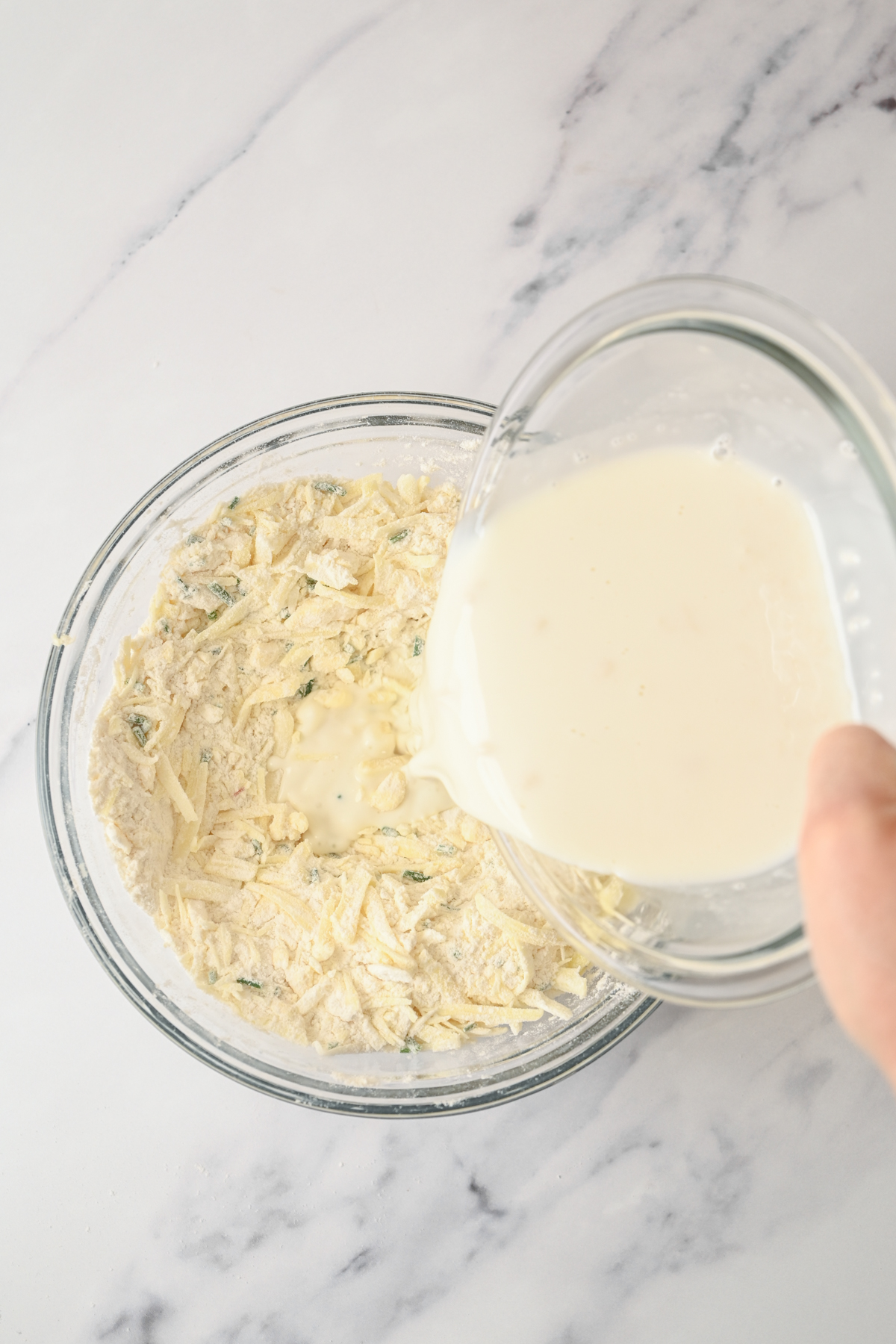
- Make a well in the middle of the flour mixture and pour in the milk and starter and mix into a shaggy and quite dry dough.
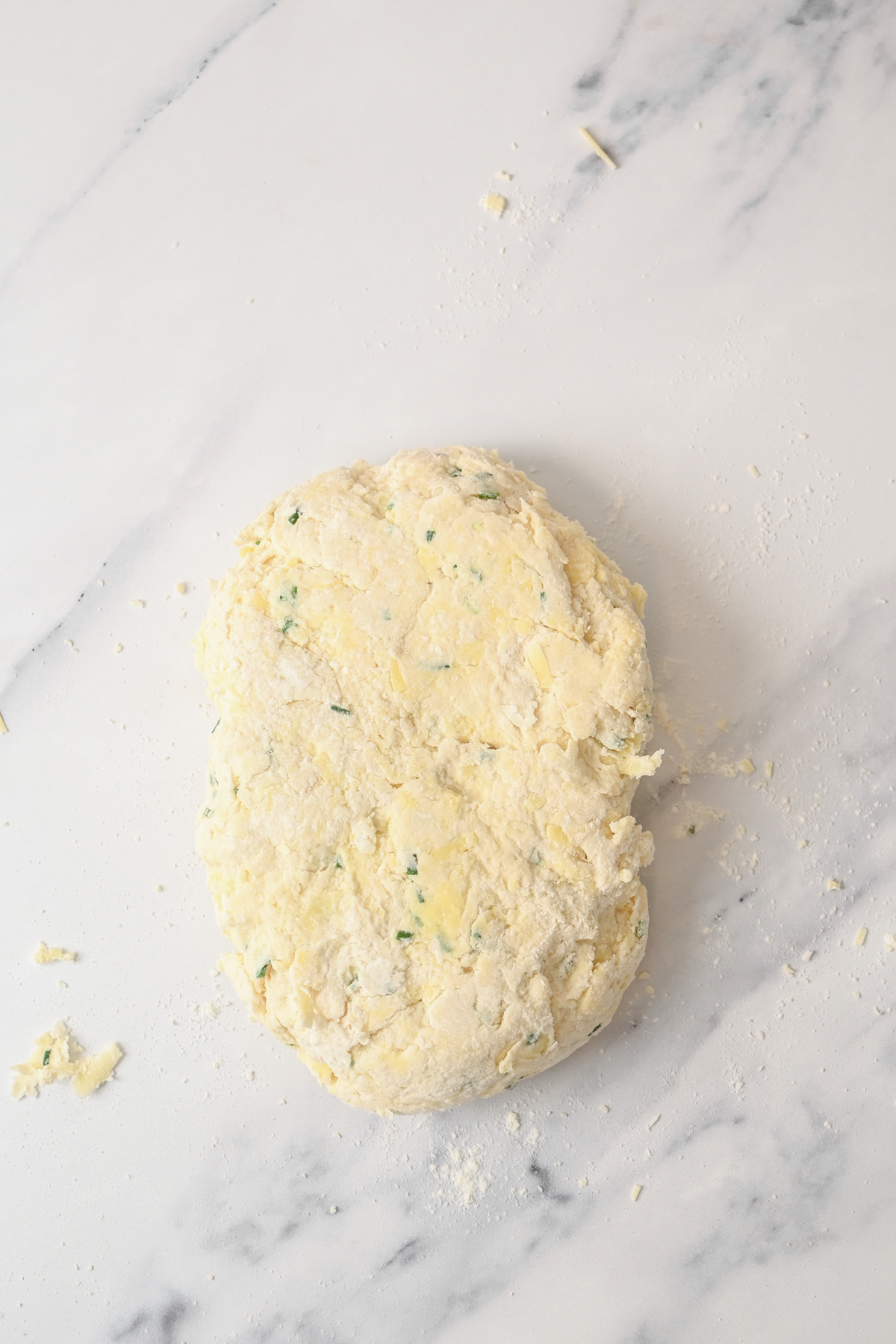
- Turn the dough out and shape it into a rectangle.
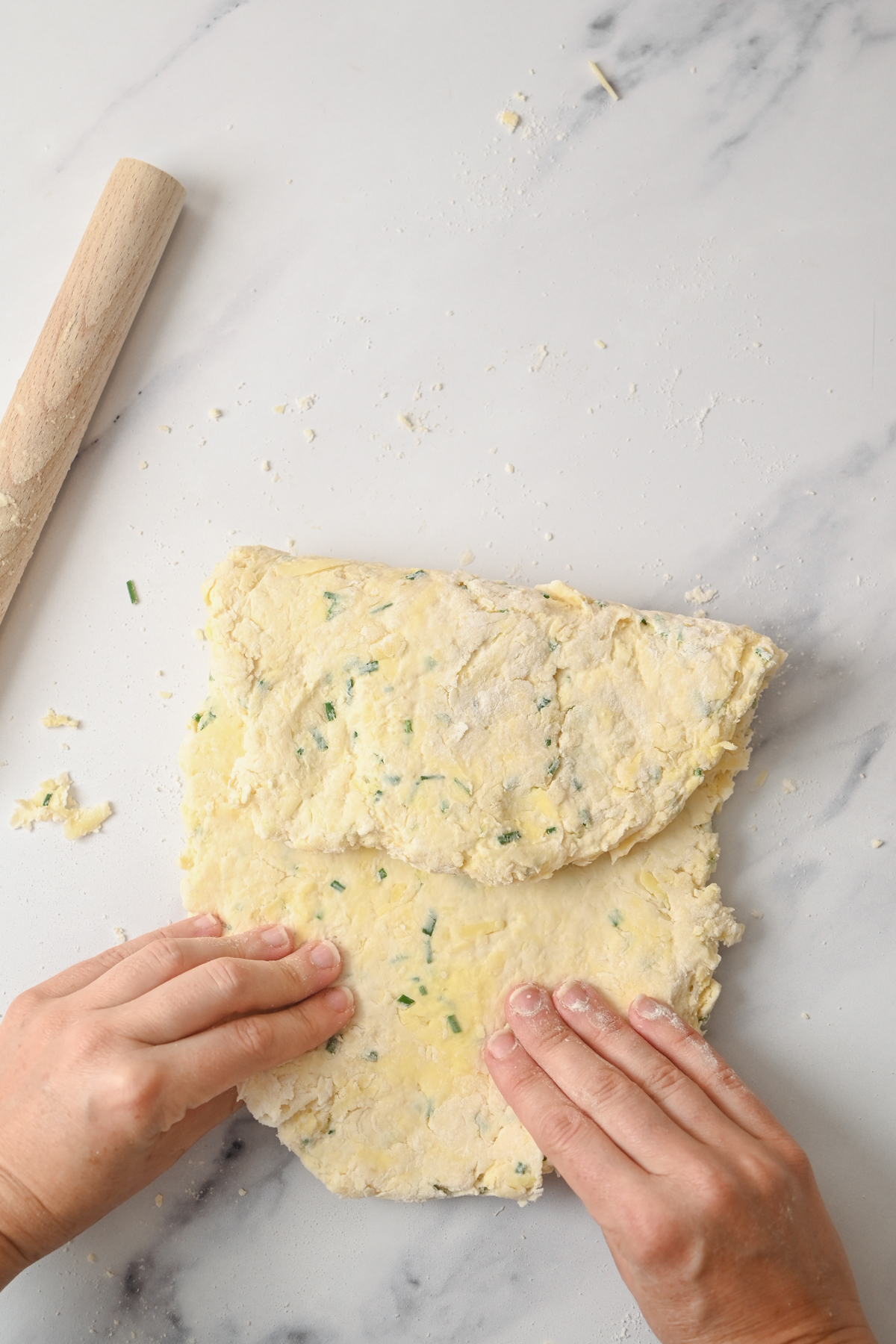
- Fold the dough in thirds, like a letter, then repeat the roll and fold.
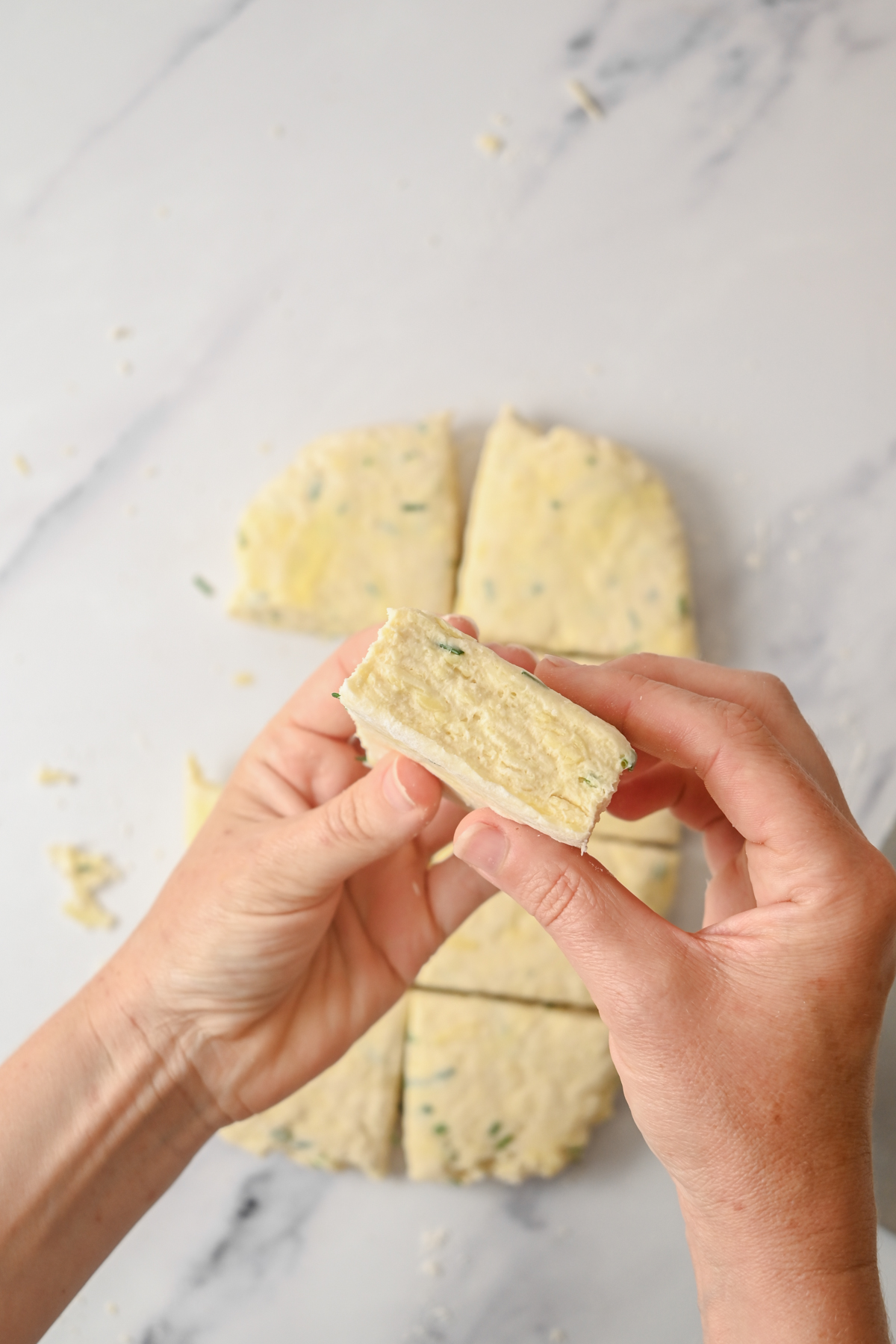
- Roll it out once more and cut into 8 or 10 pieces
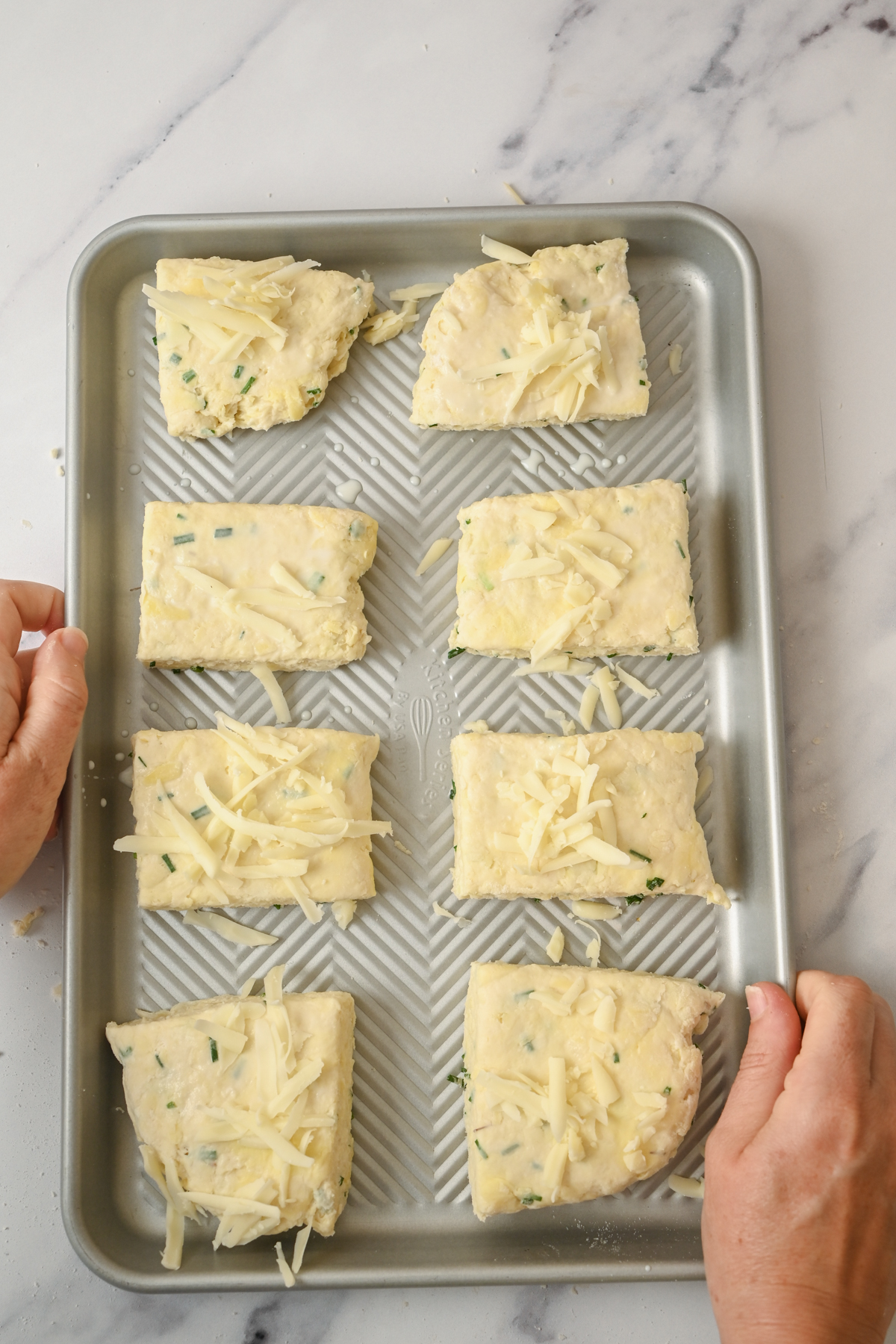
- Brush with milk and top with more cheese.
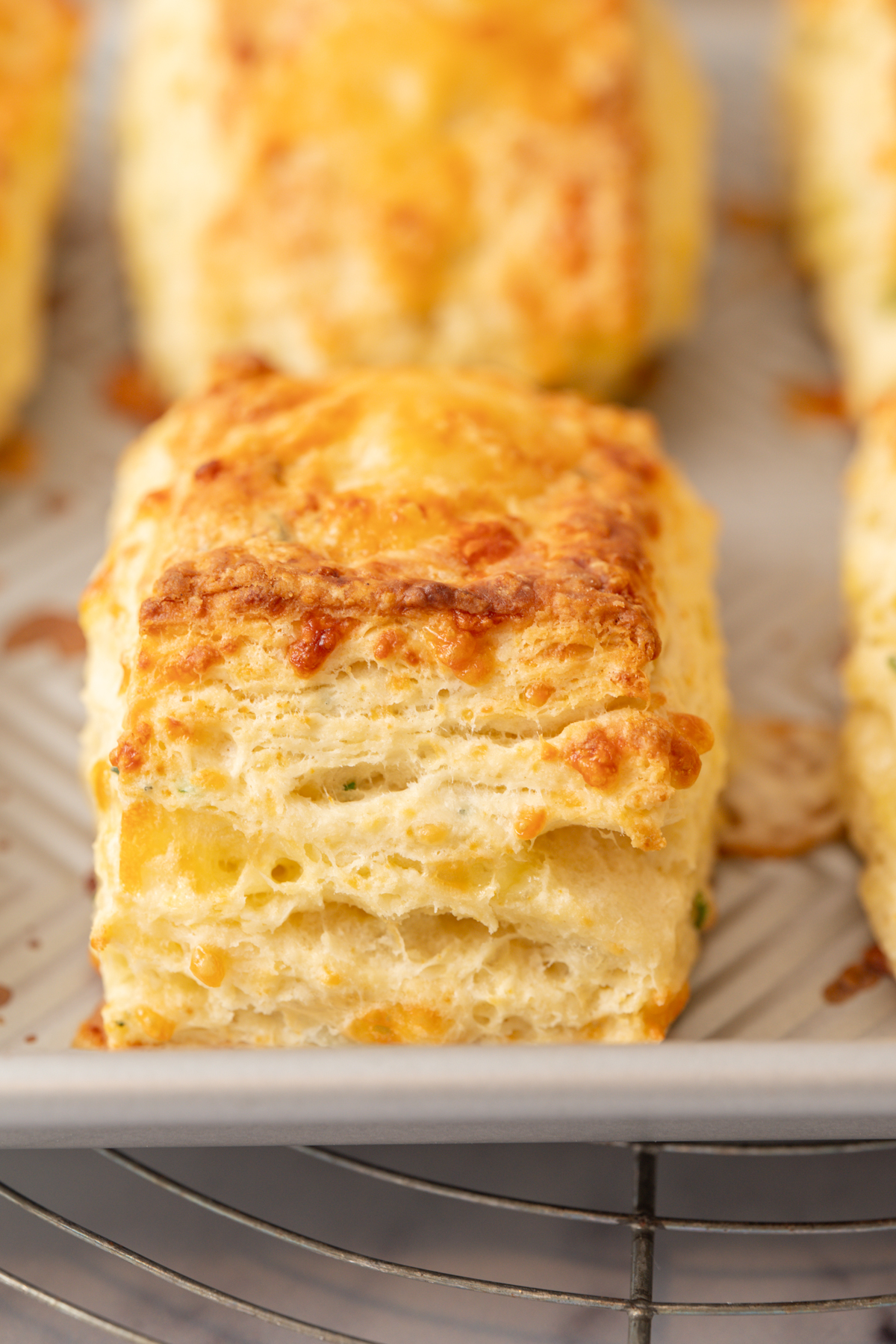
- Bake until deep golden brown and puffed.
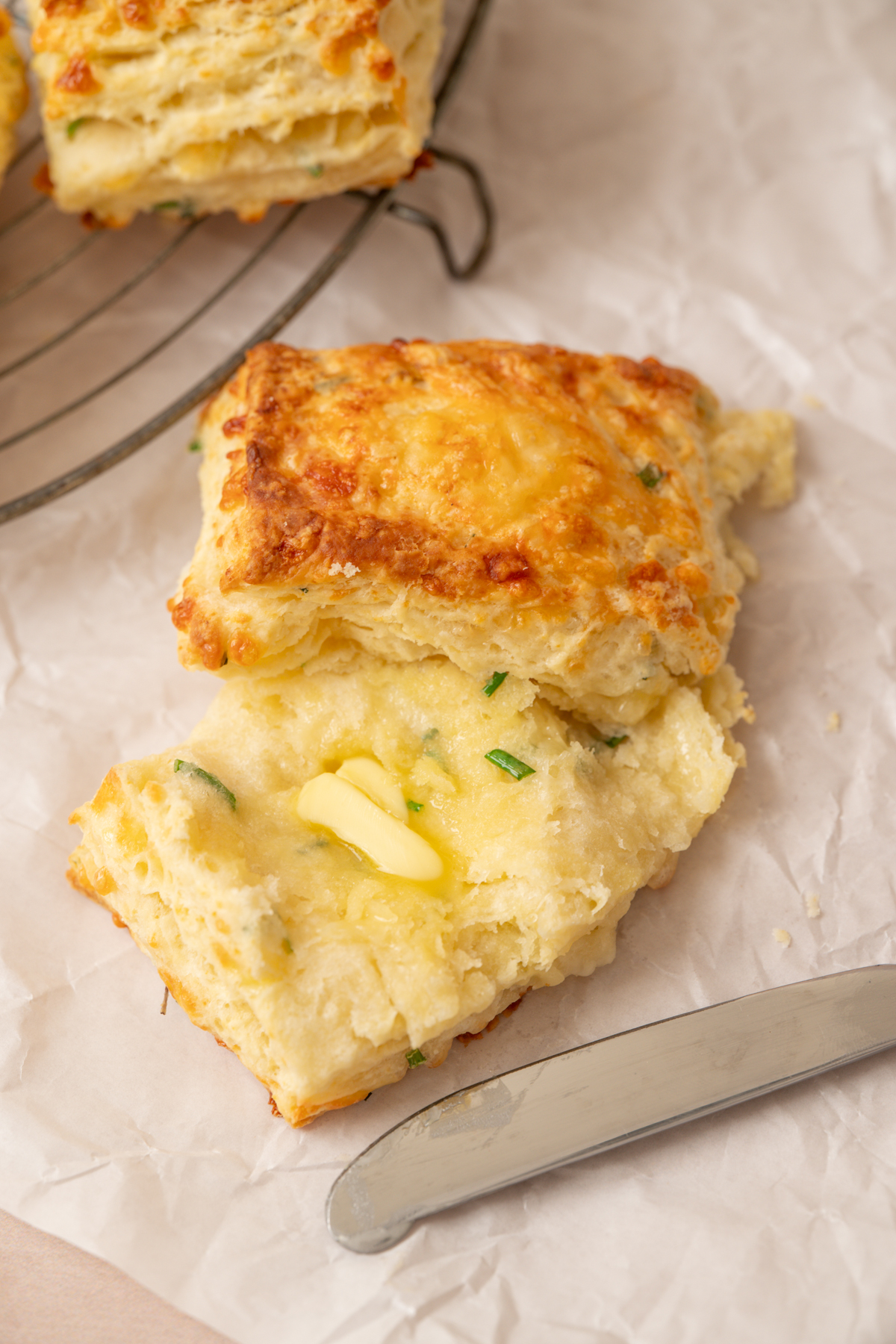
- Serve warm with a pat of butter.
Tips
- Keep everything cold. Warm butter will make greasy and more dense scones. If your kitchen is warm, put the flour in the freezer for 10 minutes before you start, and work quickly once the butter is in.
- Don’t overwork the dough. There should still be dry, floury patches when you tip it out of the bowl. It comes together as you fold it.
- How much milk to add. The sourdough discard varies in hydration, so the amount of milk you need will vary too. Add it gradually and these scones are better when the dough is too dry rather than too wet. A dough that’s too wet will spread, and the layers will merge together. If it’s a little dry, the folds will bring it together.
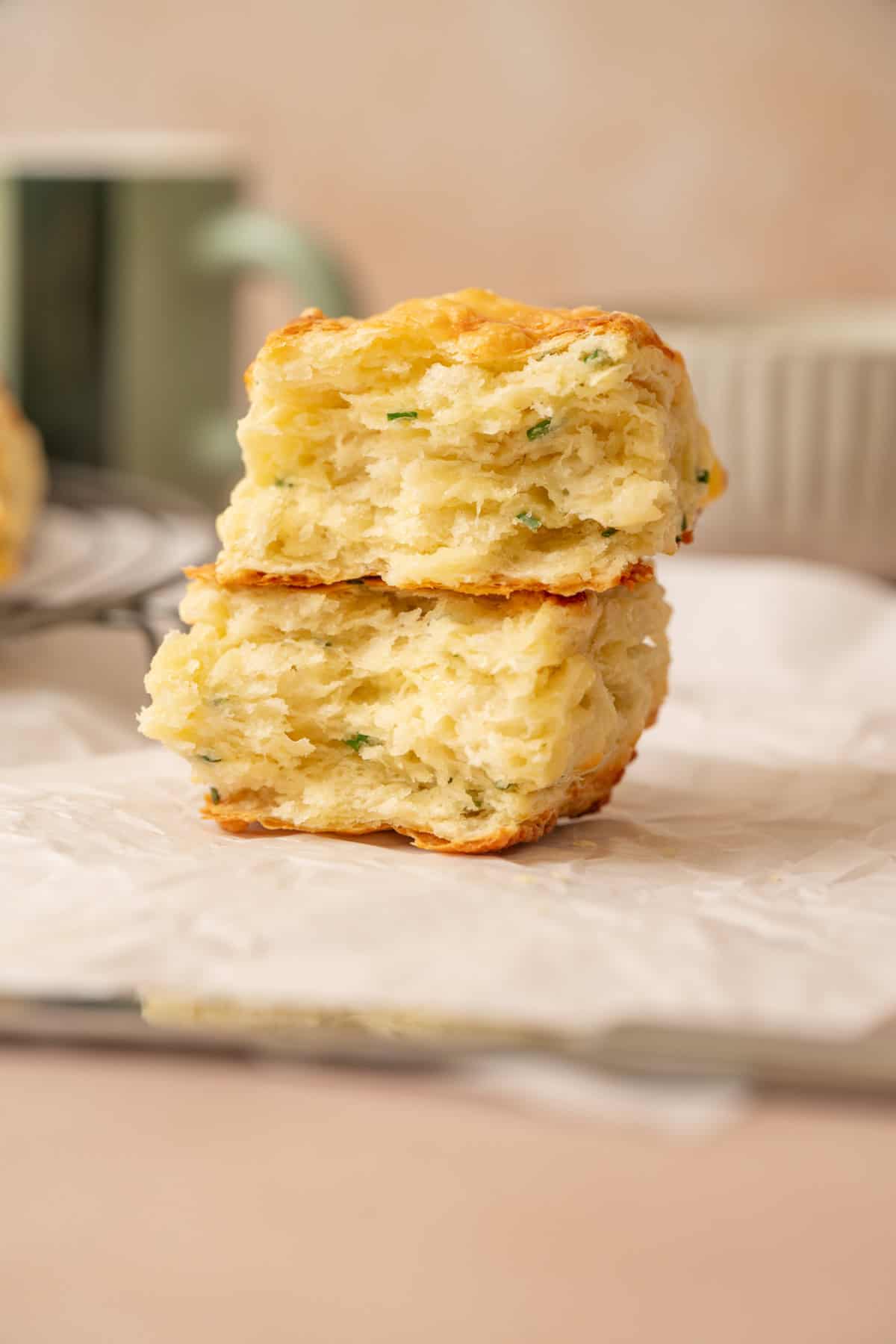
- The lamination. The fold technique is what creates the flaky layers in these scones.
- Burnt bottoms. If your oven runs hot from the bottom, place the scones on a higher rack, or stack two baking trays together to add insulation. A silicone baking mat can also help.
Storing
Baked scones keep covered at room temperature for up to 4 days. Reheat in the microwave or a low oven.
To freeze unbaked scones, shape and cut them, then freeze on a lined tray. Once solid, transfer to a freezer bag. Bake from frozen at 428°F/220°C, adding 5-6 minutes to the bake time. You can also freeze fully baked scones for up to 3 months.
Related recipes
- Sourdough focaccia
- Flaky buttermilk cheese scones
- Sourdough pain au chocolat
- Sourdough banana bread
- Sourdough pizza dough
- Pumpkin sourdough muffins
- Sourdough burger buns
- Sour cream and chive rolls
Sourdough Cheese Scones
Ingredients
- 350 g all-purpose flour
- 1 Tbsp baking powder
- 3/4 tsp salt
- 113 g unsalted butter cold and cubed
- 200 g grated cheese*
- 2 Tbsp fresh chives finely chopped
- 180 g cold milk plus more as needed
- 100 g sourdough discard starter
Topping
- 2 Tbsp milk
- Grated cheese
Instructions
- Whisk the flour, baking powder, and salt together in a large bowl. Add the cold cubed butter and use a pastry cutter or your fingertips to cut it in until the mixture resembles coarse, pea-sized crumbs. Work quickly so the butter stays cold. 350 g all-purpose flour, 1 Tbsp baking powder, 3/4 tsp salt, 113 g unsalted butter
- Stir in the grated cheese and chopped chives. 200 g grated cheese*, 2 Tbsp fresh chives
- Stir the sourdough discard into about half the milk to loosen it, then pour it into the flour mixture. Fold together with a spatula, then add more milk, 1 tablespoon at a time, until the dough just holds together when pressed. It should be shaggy and with some dry patches.100 g sourdough discard starter, 180 g cold milk
- Tip the dough out onto a lightly floured surface and push it into a rough rectangle about 7×10 inches (17x25cm).
- Lift the bottom third of the dough and fold it into the middle. Fold the top third down over it, like folding a letter.
- Turn the dough 90°, then press or roll it back out to 7×10 inches. Fold in thirds again.
- Turn the dough 90° once more and press or roll out to 7×10 inches one last time.
- Cut into 8 pieces for large scones or 10 pieces for small ones.
- Place on a lined baking tray and refrigerate while the oven preheats.
- Preheat the oven to 428°F/220°C (regular, not fan).
- Brush the tops of the scones with milk and sprinkle over a little extra grated cheese. 2 Tbsp milk, Grated cheese
- Bake for 12-16 minutes until deep golden brown. Smaller scones will need less time. Serve hot with a pat of butter.
Notes
- Cheese: Use a cheese with a strong flavor for the best result. Sharp cheddar is the classic choice. You can also mix cheeses, such as cheddar with a little parmesan or gruyere.
- Sourdough discard: Unfed discard that has been sitting for a while works best here. The more acidic it is, the more tender and slightly tangy the scones will be. Active, recently fed starter works too.
- Milk quantity: The amount you need depends on the hydration of your discard. Start with less and add more gradually. A dough that’s too wet will spread rather than rise.
- Make ahead: Shaped, unbaked scones can be frozen. Bake from frozen, adding a few more minutes to the bake time.
- Both US customary and metric measurements are provided. Use the toggle to switch between the two.


Can I use this recipe for raspberry scones? I made this recipe with cheese and bacon and they were !the bomb’!
You could but perhaps with a few tweaks. You may want to add in some sugar and maybe substitute some of the milk for an egg for some richness. 🙂
A good recipe – I used less cheese and more flat starter. Very tasty but found the butter leaked out quite a bit. Drained the melted butter back into butter dish. Tried same day bake as well as 20hr fermentation in the fridge. Both equally delicious. Definitely would make again
Can I make this using active sourdough as well?
Yup you can but the more acidic the starter(and the longer it’s left without feeding), the better for this recipe
Just found your website. So happy to see someone reply to questions with actual suggestions and not the typical “uhhh, try it and let me know how it turns out.”
Happy to have you here Debbie! 🙂
Hello! My unfed starter is pretty thick (thicker then pancake batter by a lot). Still produces good sourdough though, so I’ve never changed it. Would a thick starter like that work for this recipe?
Hey yeah for sure, you can just adapt the amount of milk as needed 🙂
This looks delicious ! But I don’t have any sourdough discard starter or active starter, can I replace it with something else?
Yup you could use buttermilk or yogurt instead. Just adapt the amount of milk added so the dough doesn’t become too wet 🙂
These are the best cheese scones I’ve ever made (and I’ve made a lot in my time) and I even skipped the 1 hour rest so will try that next time. Thank you!
Yay so happy to read this!
Can I use whole whipping cream instead of milk?
Yes you could 🙂
I am new to using sourdough discard, I am normally gf but digest sourdough well due to the fermentation process. For the fermentation step for this recipe, how does the dough ferment if put in the fridge?
Hey during the fridge stage the bacteria get to work and break down the starches in the flour 🙂
Sara,
I normally eat GF as well and can tolerate sourdough, just not too much. I make sourdough with GF flour, usually use Organic Brown Rice Flour. I use as regular sourdough bread and add baking soda and Xantham Gum, using a GF flour blend to bake (Better Batter works best for bread).
These are by far the best scones I’ve ever eaten or made. Holy hell they’re delicious! I used a sharp cheddar and they’re like heaven!
Aw yay so happy to read this! Thank you! 😃
Has anyone made and frozen before the fermentation? I’d like to make during week and takeout Saturday night for a Sunday bake? Thoughts?
Hey Marilyn, I’ve frozen the unbaked scones before with great results 🙂
Ok so if I want a citrus scone could I do that by using like a thin marmalade instead of portion of milk? And I guess a tiny bit of sugar? Or maybe for lemon, part juice/part milk and obviously some zest? I’ve looked at other recipes but I like your proportions and don’t want to mess with those.☺️
Phenomenal!!!!!! These are excellent scones that blew me away. These are in my permanent rotation.
yaay! So happy you loved them!
These are a keeper!!! Thank you for a fantastic recipe. I hate throwing sourdough discard away, and I am LOVING having these perfect crispy-edged, fluffy-middled savory scones in the freezer. I freeze them after shaping- we’re a family of three so I’ve been shaping a square and cutting into nine pieces- and pull out a few at a time to bake from frozen right before dinner, 18-20 minutes at 430F. No more emergency Pillsbury biscuits!
Rave reviews all around here. I will definitely share this recipe with anyone I meet who uses sourdough.
Thanks for the awesome feedback, Ben! I’m so happy you love them! Thanks a lot for recommending it further 🙂
Thank you! 😊 I’m going to batch make these & was hoping they baked well from frozen.
Hi, I’m new to sourdough and want to try these out. Would it be possible to do a longer ferment on these? I tried to research “how to long ferment any recipe”, but got no real answers.
Hey I now recommend freezing the shaped scones instead of refrigerating them, and baking from frozen.
I found this site through pinterest – looking for ways to use up sourdough discard. I made these on Thursday and ate 3 for dinner! Mind you, that’s all I ate, but I just couldn’t stop! They, by far, are the best savory scones I’ve made. I have another batch chilling in the fridge. Thanks so much for sharing! I like the looks of triangle scones so I shaped the dough into 2 circles and got a total of 12 scones 🙂
So happy you loved them Becca! Thanks for the wonderful feedback 🙂
I get 16-18 baby triangles from making a real long rectangle, cut in half lengthwise then zigzag cuts. Feeds more of us and crust is my favorite part of everything.
These scones were so easy to make and I can’t even describe how delicious they are! I used sharp cheddar cheese but anything would be yummy in these. These are 5 stars even though I forgot to brush with milk and sprinkle cheese before baking.
I made these today and cooked them tonight – and they are so amazing! They are the perfect texture and flavor, and I love being able to use sourdough discard in them, too. Thank you for the recipe and all of the tips. I did 18 small scones, cooked a few and froze the rest for using soon. I’ll be making these often!!
Made these yesterday, they were amazing! Next time I need to leave them in the oven slightly longer though as they were still slightly too moist in the centre. Will definitely make again! Lovely with some pickle, or chilli jam on top.
Made these yesterday and they are so good. I’m very new to anything baking and they still came out light and fluffy. One question, I would have preferred that my batch have more of a sourdough flavor to it. Would it have developed more of that flavor if I had let it rest for longer? I used discard, but I went with the minimum of 1 hour resting time.
Hey! It would have slightly more tang with a longer cold rest 🙂
This is my favorite absolute discard! I’ve used several different cheeses (Asiago is so good in this) and have even added finely chopped meats (pepperoni and bacon). I’ve done the minimum 1 hr rest and have rested them for 24 hrs. It doesn’t matter what I do, they always turn out amazing.
Yay so happy to read this! 🙂
Can I use buttermilk
Yes 🙂
I need to try these out. Adding to the menu planning for the week.
Thank you for this recipe! Using sourdough starter vs. yeast made such a noticeable taste difference! I added a bit more chives and some green onion + some pepper, Paprika, and Cayenne and Wow 😙🤌
Would using bread flour make too much of a difference, that’s all I have on hand at the moment; but, I want to try these today!
I think that will be okay, just take care to not over knead the dough
🙂
Can these be frozen after baking?
Yes 🙂
Could you substitute the chives for the same amount of garlic and herb seasoning?
Sure but I would just be mindful of the salt if it’s a salted seasoning, you might need to cut back the added salt 🙂
Does the milk need to be dairy based? I only have flax milk plus protein – would that be an acceptable substitution?
I haven’t tried this myself but I think flax milk should work, though your scones may be a bit less tender and won’t brown as much because they won’t have as much fat in them
These are some of the most ah-mazing scones I’ve had. It had a bit of butter running down in my air fryer basket so next time I’ll add a little bit less. These scones are very addictive!! Thank you so much
This went down a treat for our family. My boys who are not big scone eaters devoured these and asking me to make again. Thanks for the recipe 😊
So happy you loved them!!
I made these with freshly milled AP flour. The scones are delicious, but maybe a bit more dense than yours. Any suggestions on changes that would improve the fluffiness?
Heya freshly milled flour can make things a bit denser since the bran cuts through the gluten and it absorbs more liquid. You could try sifting out some bran first before using it.
Can I do this recipe as a drop scone?
Hey! These are more of a cut-out style, like biscuits. I’ve not tried to make them as drop scones so I’m not sure
Gorgeous, light,cheesy,buttery
Made these scones with Swiss cheese, ham and chives. They were absolutely amazing! Will definitely put these in my rotation for discard uses! Followed the recipe as it was written. Love it!
Followed the recipe to a T. Put them in the oven straight out of the fridge. All of the oil from the cheese or butter melted quickly, and the bottoms are burnt. Any tips on how I could avoid this
Hey, sorry to hear that. If your oven heats from the bottom you could try putting them on higher rack. Using a lighter colored baking pan or even stacking two trays together can help it from becoming too hot on the bottom. A silicon baking mat can also add a bit of extra insulation.
The butter leaking out a bit while baking is normal and it gives a bit more of a fried bottom to the scones. But it can leak out a bit too much if the butter isn’t evenly enough distributed. If you prefer less of that, you can cut the butter a bit smaller into the flour so it’s more evenly distributed.
Brilliant recipe. Followed exactly and they came out buttery, flaky and delicious.
So happy you loved it!! 😀
Really loved these. I used Dubliner cheese mixed with sharp cheddar, topped with parmesan and garlic salt. It was shockingly similar to Red Lobster’s cheese biscuits. Needs more salt, would air on the side of more sharp cheddar and less white cheese, even strong ones. Probably would be amazing with goat cheese and rosemary. I will definitely be making these again!!! Can’t wait to try new combinations!
Can you use vegan butter?
Hey I have not tried it with vegan butter but if you give it a go, would love to know how it goes 🙂
I tried vegan butter and the scones were good, but definitely less flavorful than the butter option. The butter option is fantastic!