

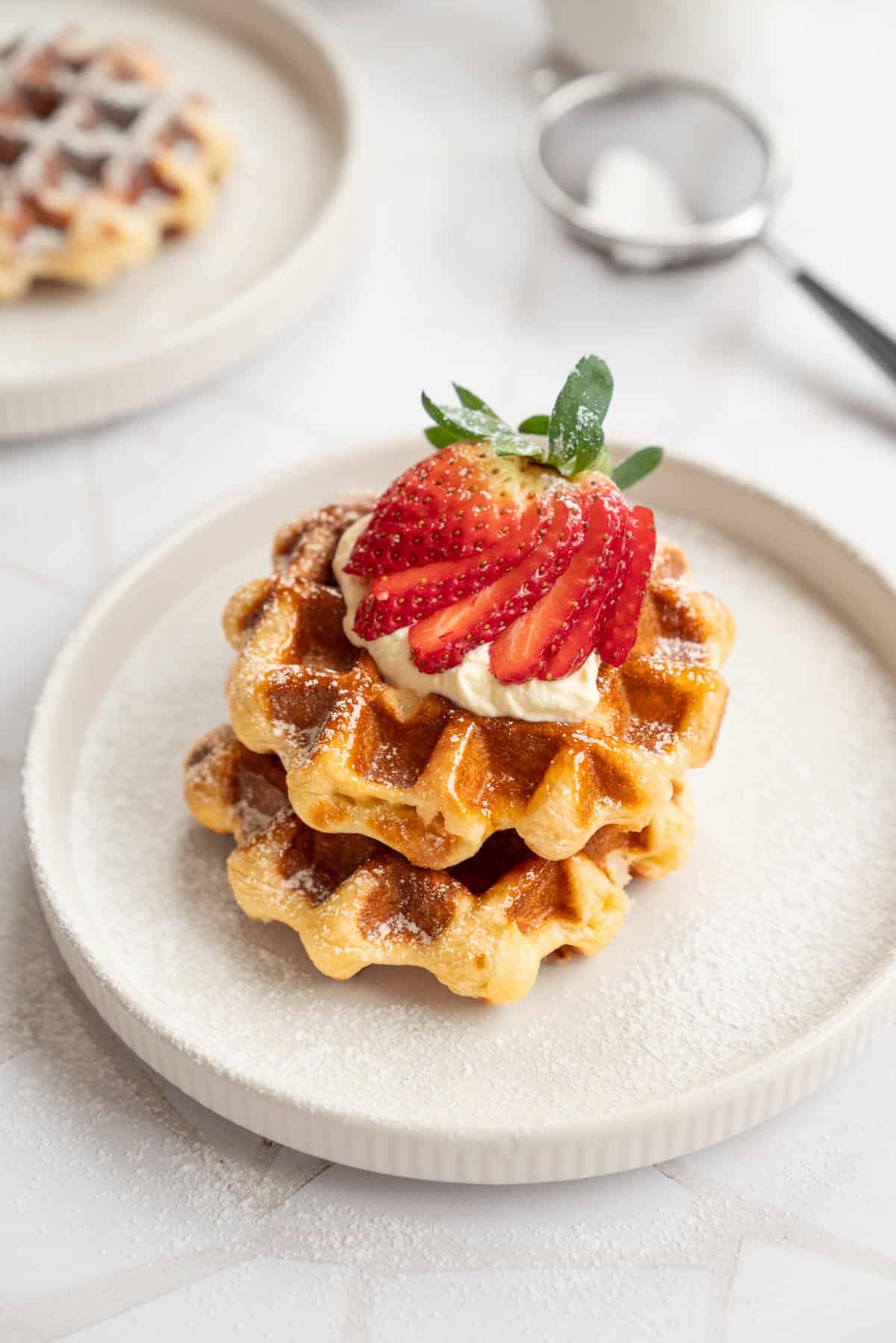

Liège waffles are sweet and dense Belgian sugar waffles made with a brioche-like yeasted dough and chunks of pearl sugar. The pearl sugar is what makes this waffle special. It gives this delicious sweet crunch against the soft brioche base.
About these Liège waffles
Belgium has two main waffle types: Brussels and Liège. My Brussels waffles post covers the lighter, airier yeasted batter waffles that you serve with powdered sugar or compote. Liège waffles (Luikse wafels) are the other Belgian waffle. They’re made from an enriched brioche-style dough rather than a batter, folded through with chunks of pearl sugar.
The dough is yeast-leavened with milk, water, egg, brown sugar, honey, vanilla, and butter. The honey is optional but traditional (all brown sugar works too). It needs to mix long enough to build a proper gluten network, and the pearl sugar gets folded in after the first rise so the chunks stay intact.
You’ll need a waffle machine with deep pockets. One thing with making Leige waffles in a home waffle machine is that they’re probably going to turn out darker than what you might buy from a vendor. The good waffle machines in Belgium have temperature control and so the waffles can cook longer on a lower temperature. But I’ve not been able to find a good one here in NZ that does the same thing. Some say they have temperature control like the Breville Smart Waffle machine I am currently using, but really it’s timing that it controls not temp. But that’s okay, they still taste great!
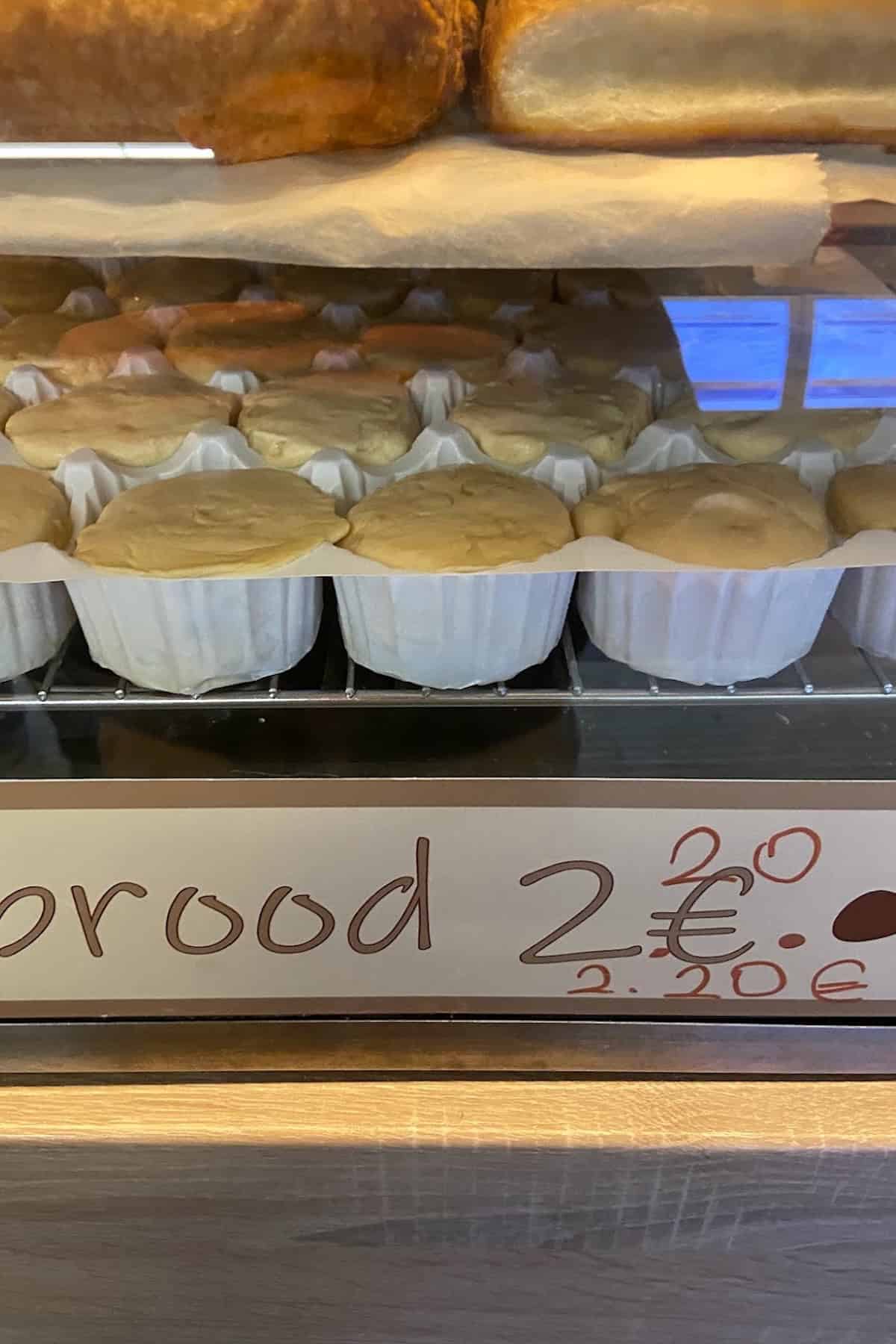

Liège waffles method
- Warm the milk and water together to lukewarm. In a stand mixer fitted with a dough hook, combine the milk, water, yeast, brown sugar, honey, vanilla, eggs, flour, and salt. Mix on low until a thick, sticky dough forms.
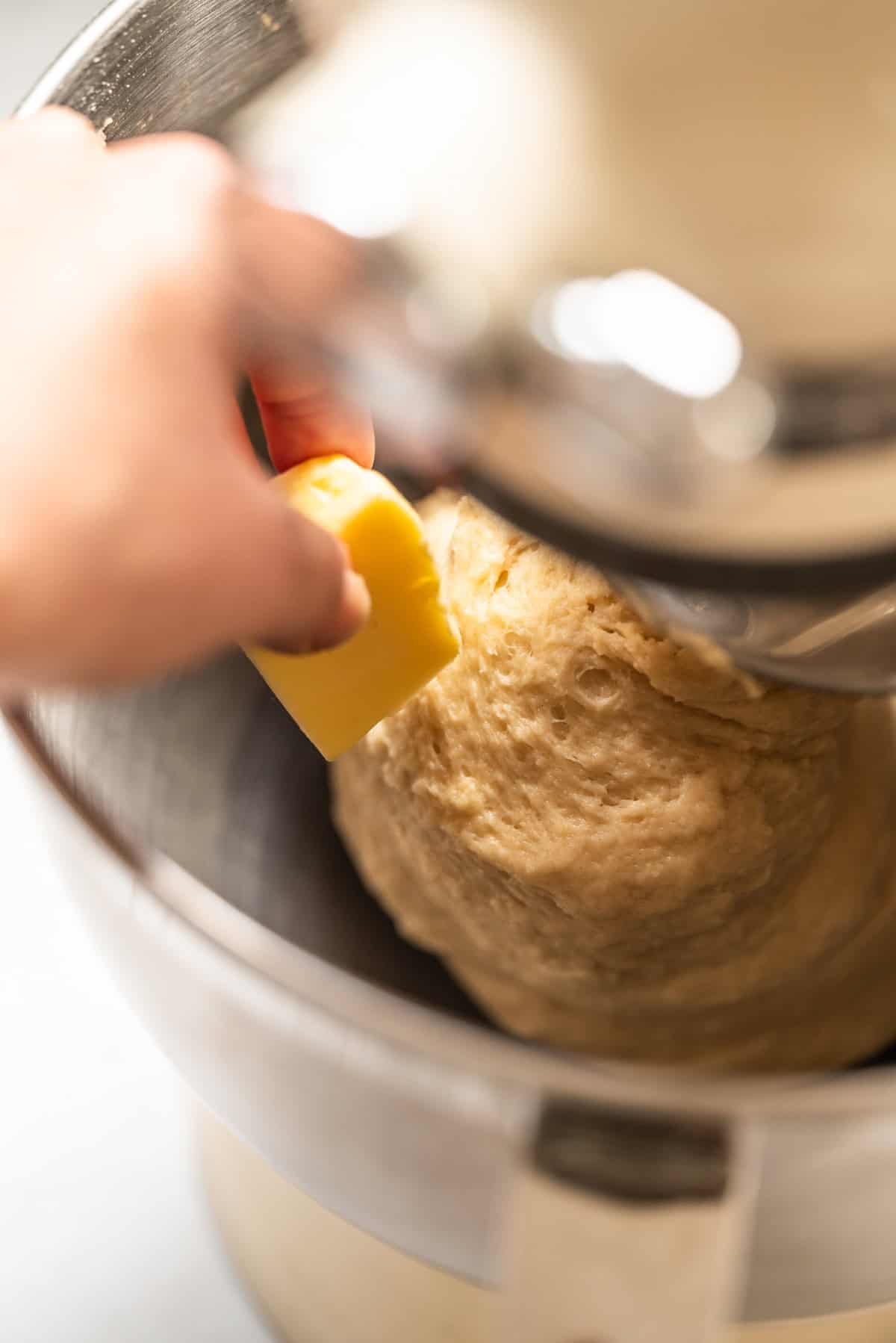
- Add the softened butter a few cubes at a time with the mixer running on low. Continue kneading for 10 to 15 minutes until the dough is smooth, elastic, and pulls cleanly from the sides of the bowl.
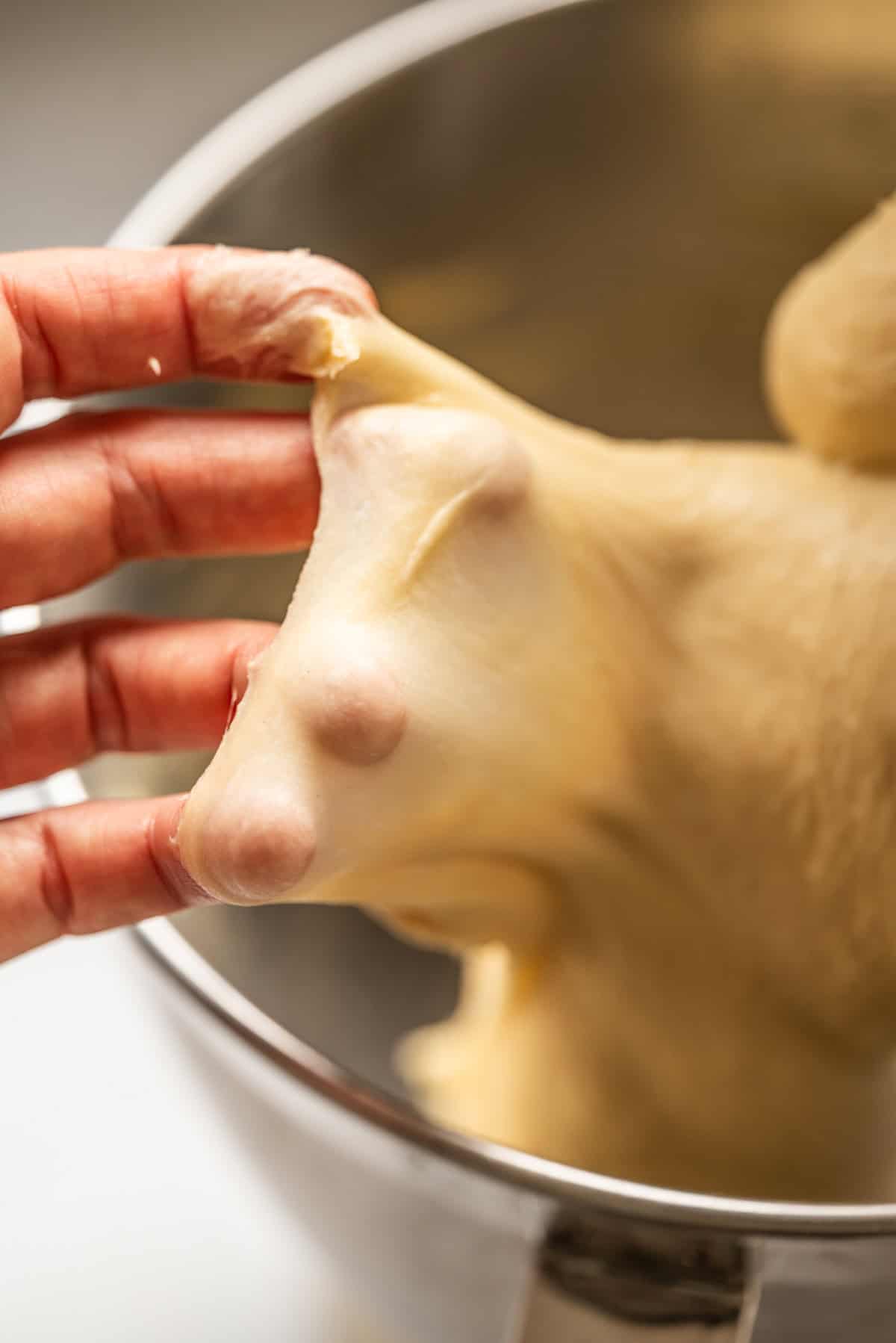
- It should pass the windowpane test. The dough is on the wet side and needs enough kneading time to build a proper gluten network.
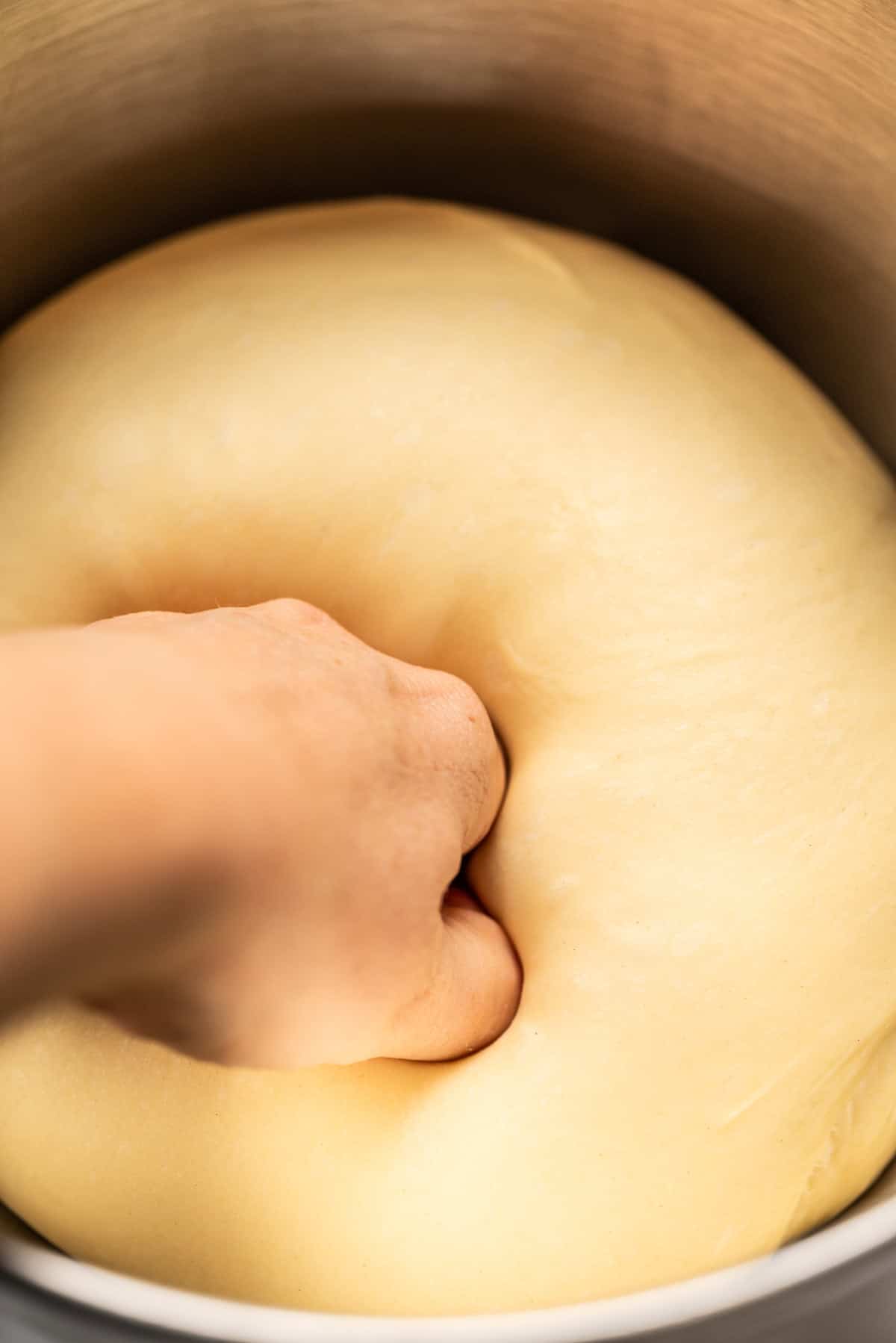
- Cover the dough and let it rise at warm room temperature until it’s grown by about 50%, roughly 1 to 1.5 hours. It doesn’t need to double.
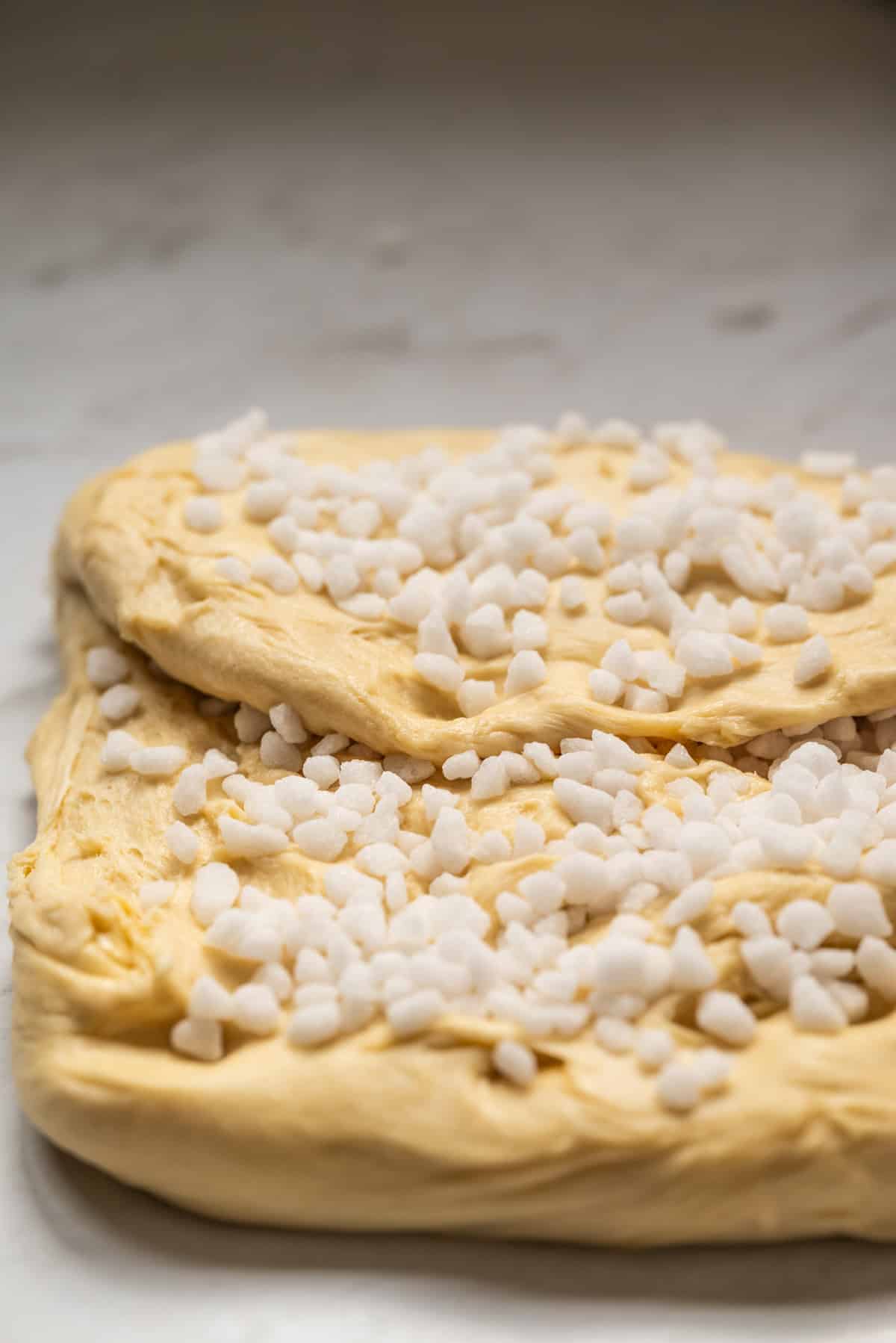
- Sprinkle the pearl sugar over the risen dough and fold it through, either in the bowl or by tipping the dough out and using letter folds on the bench.
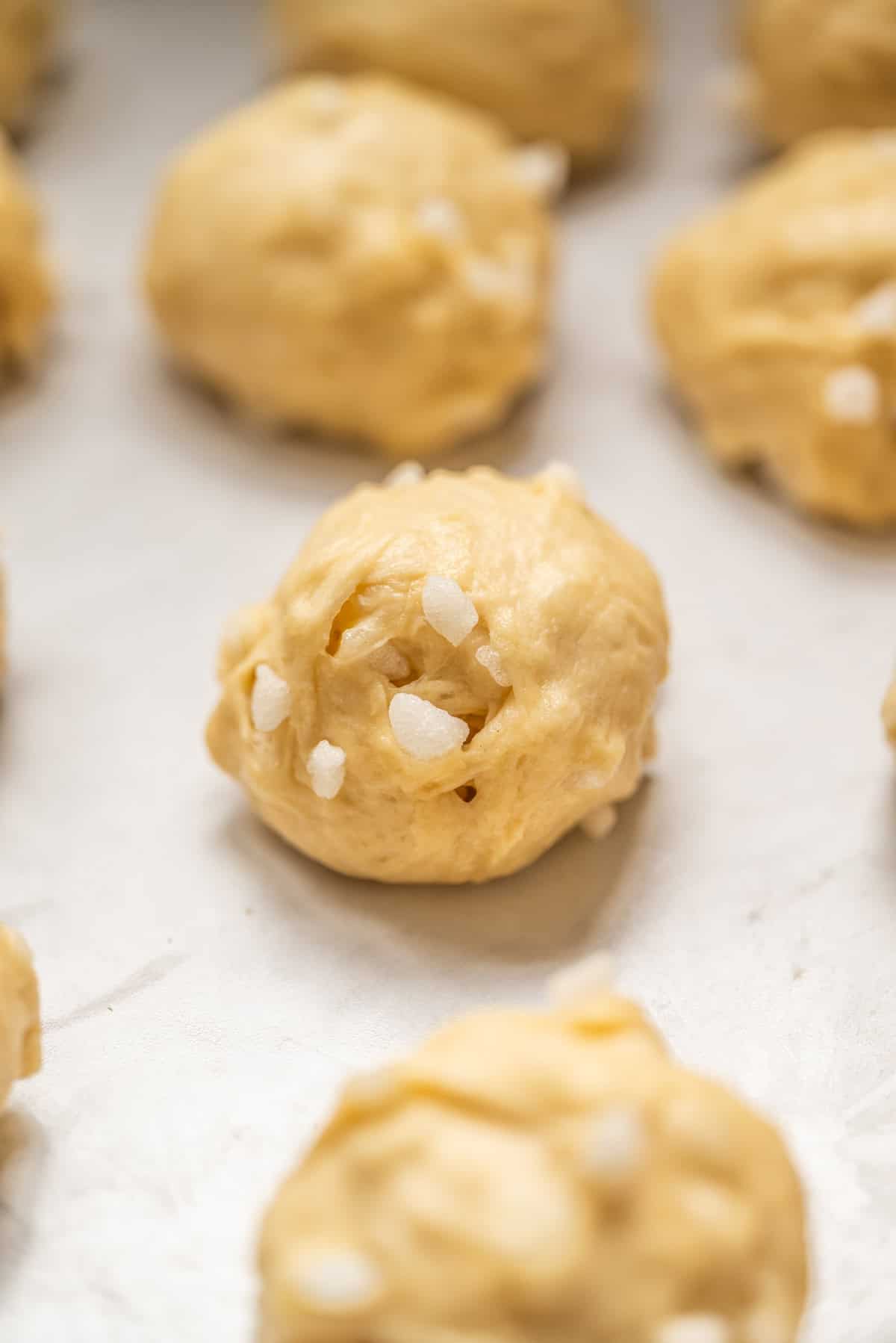
- Divide the dough into 12 equal pieces and shape into balls. They don’t need to be perfect. Place on a parchment-lined tray, cover loosely, and let rest for about 40-60 minutes while you preheat the waffle iron.
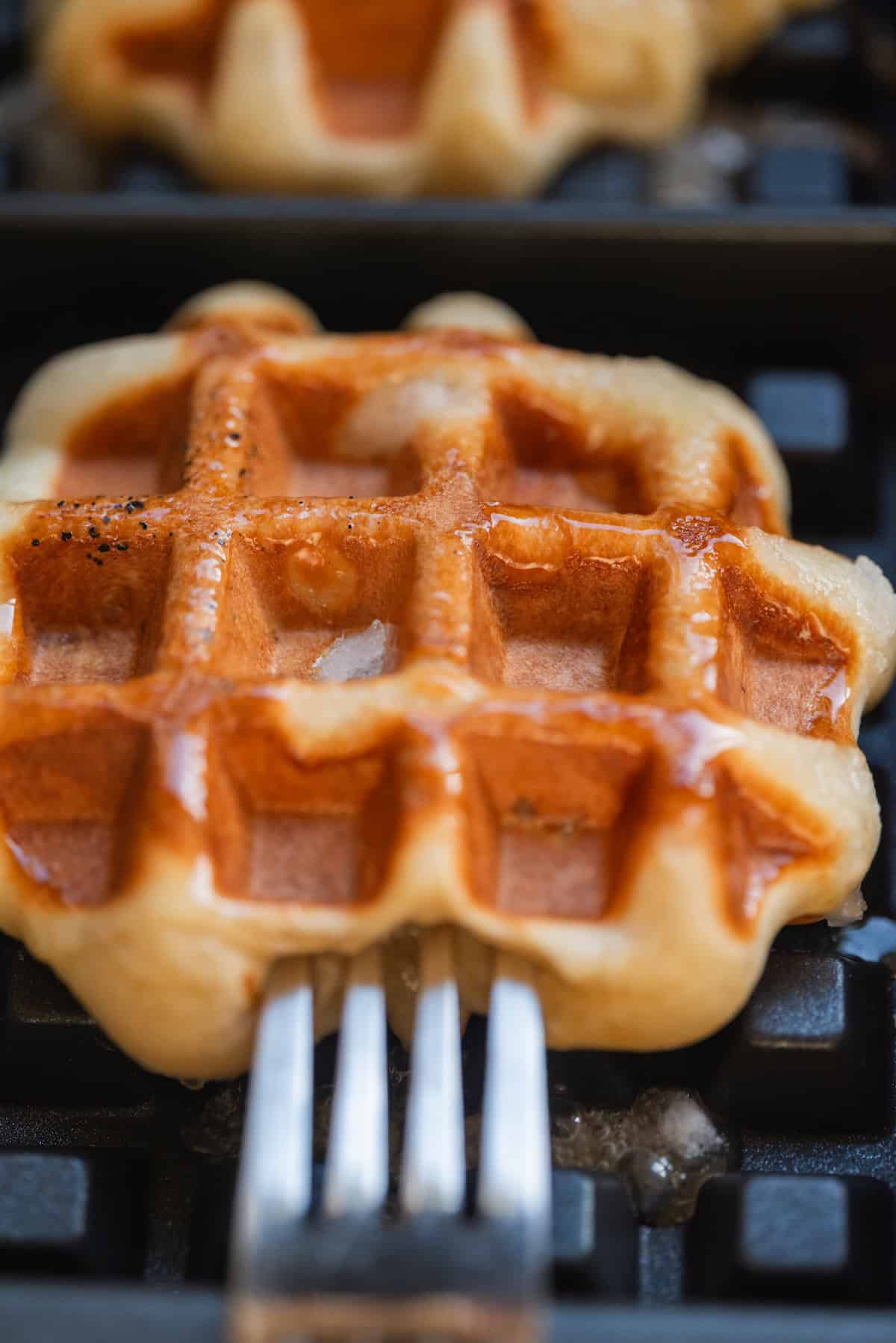
- Preheat a Belgian waffle iron until fully hot. Place one dough ball in each pocket and close the iron. Bake until deep golden brown and the sugar is caramelized around the edges.
- Use a fork or wooden skewer to gently lift the waffles out of the iron. Never use your hands cause that sugar is so hot! Let them cool on a wire rack for a few minutes before eating.
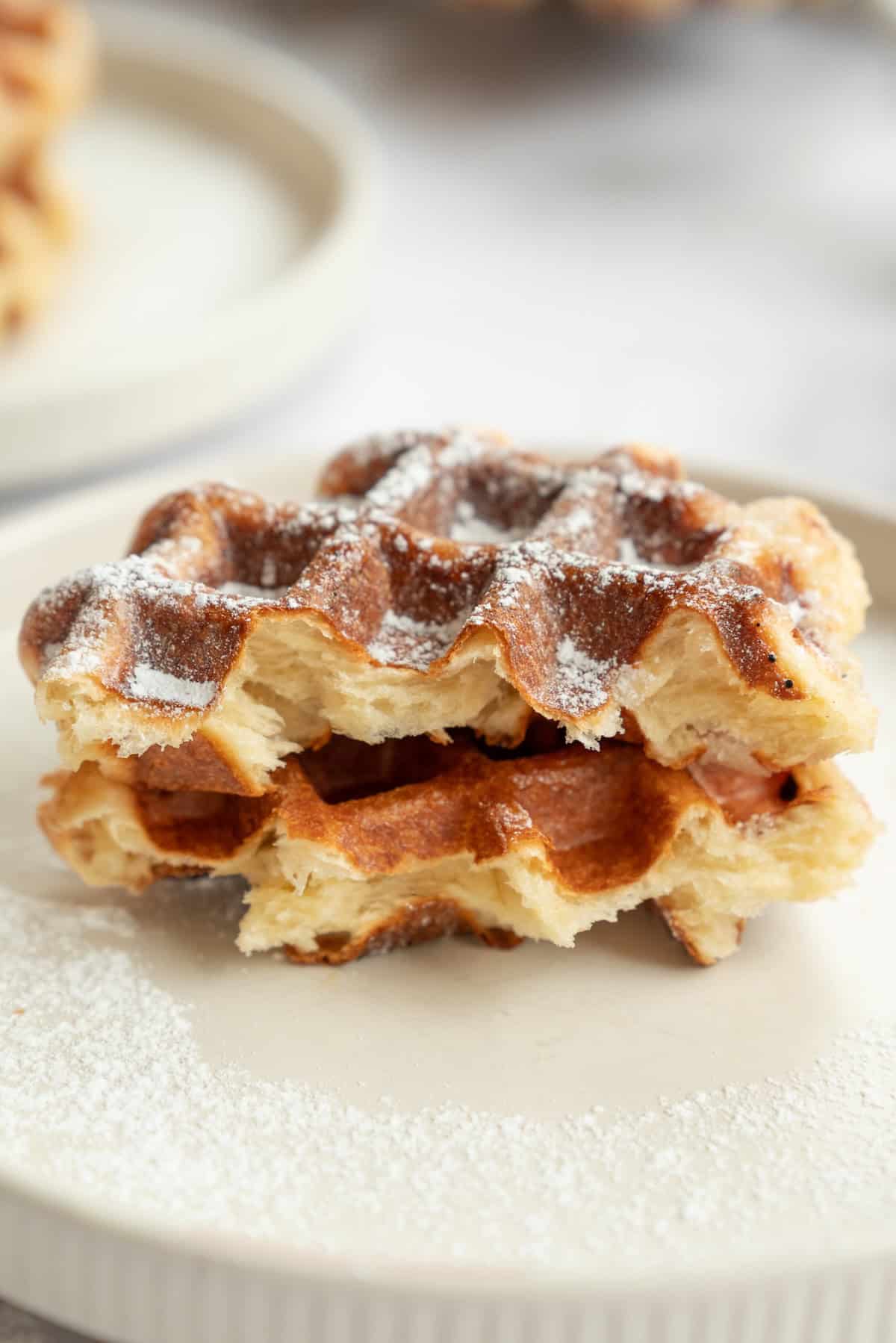
Tips for the best Liège waffles
- Use real Belgian pearl sugar. The bigger chunks are what give Liège waffles their signature crunch.
- Mix long enough to build strength. The dough needs enough kneading in the stand mixer to develop enough gluten structure.
- If the butter starts melting out, chill the dough. Enriched doughs with high butter content can warm up during long kneading. If you notice the dough getting greasy or the butter starting to separate out rather than emulsify in, stop the mixer and pop the whole bowl into the fridge for 15 to 20 minutes before continuing.
- Shape doesn’t need to be perfect. Rough balls or circles are fine. Liège waffles get pressed into the iron anyway, so the shape gets made there.
- Optional overnight cold ferment for more flavor. If you want to make the dough the night before, mix it and let it do a short room-temperature rise until slightly puffy (30 to 45 minutes), then cover tightly and refrigerate overnight.
- A quick fridge chill can help if warm dough is hard to shape. If your kitchen is warm and the dough feels soft and sticky during shaping, a 15-minute chill in the fridge will firm it up enough to handle.
- Eat them soon after baking for best texture. Let the sugar cool down a bit and then eat, they are the best when warm!
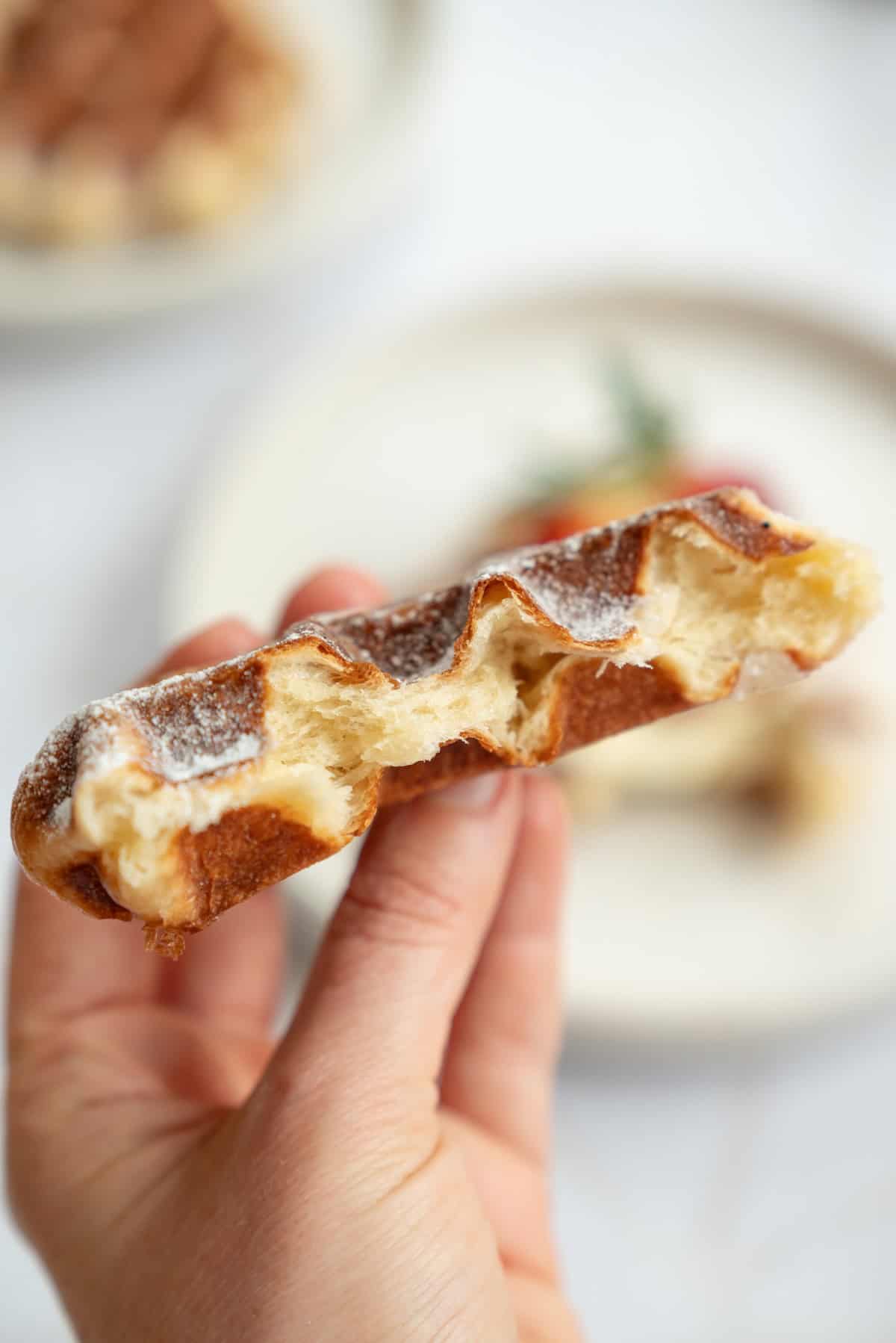
Storing
Liège waffles are best fresh, but they store well. Store leftovers in an airtight container at room temperature for up to 2 days. Reheat in a waffle iron on low heat for a minute or two to bring back some of the crispness, or briefly in a toaster.
You can also freeze them for up to 2 months. Cool completely, then freeze in a single layer on a tray before transferring to a freezer bag. Reheat from frozen in a toaster or hot waffle iron.
Liège Waffles
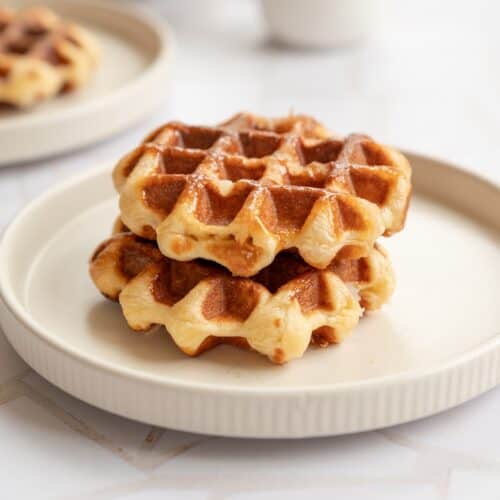
Ingredients
Dough
- 120 g whole milk lukewarm (around 95°F / 35°C)
- 60 g water lukewarm
- 2 tsp instant yeast
- 30 g light brown sugar packed
- 20 g honey or more brown sugar
- 1 tsp vanilla extract
- 2 large eggs room temperature
- 440 g all-purpose flour around 11% protein
- 1 tsp salt
- 170 g salted butter room temperature, cubed (1 1/2 sticks)
Folded Through After the First Rise
- 180-200 g Belgian pearl sugar the larger, irregular kind used for Liège waffles
Instructions
Make the Dough
- Warm the milk and water together to lukewarm (around 95°F / 35°C). In the bowl of a stand mixer fitted with a dough hook, combine the milk, water, yeast, brown sugar, honey, vanilla, eggs, flour, and salt. Mix on low until a thick, sticky dough forms, then continue mixing on low for 5 minutes to start developing the gluten. 120 g whole milk, 60 g water, 2 tsp instant yeast, 30 g light brown sugar, 20 g honey, 1 tsp vanilla extract, 2 large eggs, 440 g all-purpose flour, 1 tsp salt
- With the mixer running on low speed, add the softened butter a few cubes at a time. Don't add the next piece until the previous one has been fully worked in. Continue kneading on low for 10-15 minutes or until the dough is smooth, elastic, and pulls cleanly from the sides of the bowl. The dough should pass the windowpane test. 170 g salted butter
First Rise
- Shape the dough into a ball, place in a lightly greased bowl, and cover. Let rise at warm room temperature until the dough has grown by about 50%, roughly 1 to 1.5 hours. It doesn't need to double.
Fold in the Pearl Sugar
- Sprinkle the pearl sugar over the risen dough. Fold it through, either in the bowl with a spatula or by tipping the dough out onto a lightly floured surface and using letter folds (fold in thirds, sprinkle more sugar, fold again). Don't overwork it, the sugar chunks should stay intact. Don't add the sugar to the mixer or the dough hook will crush the chunks. You can also divide the dough into 12 first and roll the sugar into each individual piece if that's easier for you. 180-200 g Belgian pearl sugar
Shape and Rest
- Divide the dough into 12 equal pieces (about 90 g each) and shape each into a rough ball or circle. They don't need to be perfect. Place on a parchment-lined tray, cover loosely, and let them rise for around 45-60 minutes until slightly puffed.
Bake the Waffles
- Preheat a Belgian waffle iron until fully hot. Grease it, then place one dough ball in each pocket and close the iron. Bake for 3 -3 1/2 minutes until deep golden brown and the sugar is caramelized around the edges.
- Use a fork or wooden skewer to gently lift the waffles out of the iron. Place on a wire rack to cool for a minute before eating. Repeat with the remaining dough balls.




Best Liège waffle recipe I have tried! These waffles were delicious and coming from a Belgian that means something ☺️. Thanks for another great recipe!
So happy to hear you loved them 😀 thank you!
amazing taste I just wanted to eat one after another but they are precious only twelve so I need to save them
Thank you for your lovely review! 😀